
How to Play Vibrato on the Classical Guitar, Part 3
Guitar Technique Tip of the Month
Your Personal Guitar Lesson


Contact Me
Do you have a question?
Comment?
Suggestion for the website?

PDFs and Video Downloads
You may download a PDF version of this technique tip.
Download Whole Lot of Shakin' Goin' On, Vibrato Part 3
Note: You must have Adobe Reader 10 or later installed on your computer to play the videos contained in the PDFs. Download Adobe Reader here.
WHOLE LOT OF SHAKIN' GOIN' ON: Vibrato Part 3
PART 3—The Final Chapter
How to Execute Vibrato
Copyright Douglas Niedt. All Rights Reserved. This article may be reprinted, but please be considerate and give credit to Douglas Niedt.
The Transversal Vibrato
The transversal vibrato is also called the vertical, lateral, and lateral-bend vibrato. Honestly, I have always thought of it as an inferior type of vibrato suitable primarily for electric and acoustic steel-string guitar playing, especially for blues and heavy metal soloing. When I say inferior, I don't mean any reference of inferiority to the music or type of guitar, but simply inferior in the sense that it only goes on the sharp-side of the mean tone rather than circling it as vocal vibrato and longitudinal guitar vibrato do.
But, as you have read, sharp-side vibrato has a history of being used on the viola da gamba. As far back as 1659 (!!) in The Division-Violist, Christopher Simpson shows the notation for a "sharp-side" vibrato. He cleverly writes it as a trill-like effect in the confines of one space on the staff:
Example #1

Granted, the execution of this vibrato on the gamba differs from that on the guitar. But the important point is that the end result is a "sharp-side" vibrato.
Danoville, in his L'art de toucher le dessus et basse de violle (1687) calls the gamba technique the battement and says it "fills the ear with languishing sweetness." Jean Rousseau, in his Traite de la viole (1687) also calls it the battement. He describes it as an imitation of a certain gentle agitation of the voice. He says it is used any place where the length of the note permits it and that it is done for the full extent of the tone.
So you head-bangers and blues players out there; while you may not be shooting for "languishing sweetness," when you are wailing away on a solo using your transversal vibrato, pause for a moment in wonderment that you are using an effect that dates back at least to the 17th century.
Execution of the Transversal Vibrato
Whereas the basic longitudinal vibrato is produced by the swinging of the arm and hand against a fixed stationary finger (sometimes with, sometimes without the thumb on the neck) the transversal vibrato is produced by the finger alone with the thumb firmly on the neck.
The finger itself, by flexing its tip and middle joints, moving parallel with the fret, stretches the string towards the palm of the hand and then releases the string in a smooth rhythmic movement. In other words, the string is being stretched side to side.
To make the movement mechanically efficient and therefore relatively effortless, place the palm of the hand (specifically, the spot at the base of the index finger) against the lower side (the side closest to the ground) of the neck. This serves as a point of leverage. It isn't absolutely necessary to do this (and sometimes you can't) but it does make it easier to pull the string.
If you are using the transversal vibrato on the treble strings, it is usually best not to use a knuckles- parallel-with-the-neck hand position. That position restricts the transversal finger movement, especially on the first and second strings. Instead, allow the 4th finger side of the hand to swing away from the neck. On the bass strings, either position may be used depending on which finger is being used and the length of your fingers.
Watch as I demonstrate all these points in this stunning, Oscar-nominated video clip #1:
One problem that can crop up when using transversal vibrato on the 1st string, is accidentally pulling the string off the side of the fingerboard. You either have to use a narrower vibrato (don't pull the string so far) or push the string upward toward the 2nd string instead of pulling it down toward the floor.
Even if pulling the 1st string off the fingerboard is not a problem, you still have the options of pushing the strings upward instead of down, or even both down and up. Pushing the string upward has an advantage in situations involving adjacent strings:
Example #2
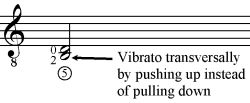
If we want to vibrato the 5th string B and try to pull downwards as in a conventional transversal vibrato, we will probably kill (damp or mute) the open 4th string. Instead, if we push up to vibrato we won't come into contact with the adjacent open string.
Or:
Example #3
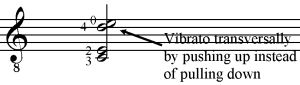
If we want to vibrato the 2nd string D, if we pull down on the 2nd string, we are in danger of muting the open 1st string. Instead, push up.
You can see the problems and solutions in this mesmerizing video clip #2:
Transversal vibrato is useful for dramatizing a single note in a chord rather than vibratoing the entire chord, especially large bar chords in lower positions:
Example #4
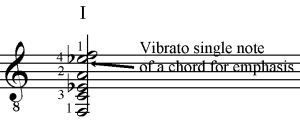
In the above example, we can transversally vibrato the 4th finger on the Eb rather than trying to vibrato the entire chord.
Transversal vibrato is also useful to vibrato the entire bar chord. Sometimes, it is easier and more effective to transversally vibrato a few notes within a bar chord (which gives the effect of the entire chord being vibratoed) than to try to longitudinally vibrato the entire chord:
Ex. #5
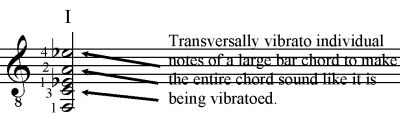
This can be useful regardless of what fret the bar is on. It doesn't apply to only the lower regions of the fretboard.
Watch as I demonstrate this very useful technique. You will surely be riveted to your seat on this one, folks (video clip #3):
Summary of Uses of the Transversal Vibrato
- In general, the transversal vibrato is favored for use below the 5th fret.
- Some players prefer it above the 12th fret. (I prefer the longitudinal vibrato everywhere above the 3rd fret.)
- Use it to vibrato a single note within a chord or interval anywhere on the fretboard to emphasize or dramatize that note.
- Use it to vibrato several notes within a bar chord without having to longitudinally vibrato the bar itself. This produces the effect of the entire chord being vibratoed.
A Top Secret Transversal Vibrato Tweak
As we know, the transversal vibrato only goes "sharp-side" of the mean pitch of the vibratoed note. When I do a transversal vibrato, whenever possible, I compensate for its innate sharpness by pushing the string longitudinally to the right at the same time. This makes the pitch go flat roughly the same amount the transversal pull makes it go sharp. The result? A perfectly in-tune transversal vibrato.
Watch this, vibrato freaks (video clip #4):
How and When Do I Use Vibrato?
A guitarist could just "wing it" and use vibrato as he feels inspired at the moment. But it is such a powerful and expressive tool that I think it is best to meticulously plan for its use.
Its most basic use is to add fullness to one's sound. Vibrato was an important part of the famous "Segovia sound." Segovia's lush, beautiful tone combined with his amazing vibrato technique resulted in a singing tone seldom equaled by anyone since. It is hard to hear on his poorly engineered (in my opinion) recordings, but those who heard him live will never forget that sound.
Christopher Parkening, in his superb recordings, emulates the Segovia sound very successfully. The Parkening sound is simply drop dead gorgeous, especially on his earlier EMI/Angel recordings produced by Patti Laursen.
One of the main things to keep in mind is that vibrato adds emphasis and intensity to any note to which it is applied.
Here is a list of a few ways to use vibrato artistically in your playing:
- Add emphasis to a single note within the context of other notes that are not vibratoed at all or very little.
- Give the illusion of longer sustain to long notes and chords.
- If a melody is in the bass register with accompaniment above, vibrato the low notes of the melody but use no vibrato on the accompaniment notes above. This will make the melody in the bass stand out. Listen to Segovia play a portion of Cuna from Mompou's Suite Compostelana.
- Use vibrato to add intensity to a crescendo. Begin a phrase quietly with no vibrato. As you crescendo, add more vibrato. The speed and/or amplitude of the vibrato can be increased or varied depending on the effect desired.
Watch as I demonstrate how vibrato can enhance your changes of dynamics. George Lucas and Spielberg were speechless after watching this (video clip #5):
- Use vibrato to emphasize a decrescendo. After playing loudly perhaps with heavy vibrato, lighten the vibrato's intensity by slowing it down and decreasing the amplitude as you make your decrescendo.
- Along these same lines of using vibrato to "amplify" crescendo and decrescendo, let's remind ourselves that the guitar has a relatively limited dynamic range. The use of prominent variation of the speed and amplitude of the vibrato can actually take the place of volume changes in passages where we need to conserve our dynamic range in order to "let loose" in a later passage.
- When it comes to vibrato, less is not necessarily more. In romantic period music (Tárrega, Albéniz, Granados, Llobet) vibrato is an essential and prominent ingredient of the era's sound and sensibility. If you want to play romantic period music authentically, use a lot of vibrato. It doesn't matter if the piece you are playing was written for the piano (which of course cannot really produce vibrato though Franz Liszt would disagree—as pointed out in Part I of this article, he actually specified vibrato in some of his piano works). You are playing a string instrument and the language of the period demands the use of prominent vibrato on any instrument capable of producing it.
- Use vibrato to vary repeats or repeated passages. Instead of (or in conjunction with) color changes or changes of dynamics, use no vibrato on the first appearance of the passage and prominent vibrato on the repeated passage, or vice versa. Or vary the speed and/or amplitude of the vibrato on the repeated passage.
- When playing with another guitarist, decide how you will each use vibrato. It would sound wrong if one player used vibrato frequently and the other hardly at all. On the other hand, planning the use of vibrato in one part but not the other can be very effective. One player could use heavy vibrato on a particular section in contrast with light or no vibrato by the other player in his part.
- Some players recommend the occasional use of vibrato to cover up intonation problems. I don't think it's a particularly effective use of the technique. Instead, use good strings and tune properly to begin with. But maybe in a pinch? However, according to Gerhard Mandel in Cello Technique (see Part 2 of this article) it wouldn't make much if any difference.
Dealing With the HIPPLFs
Historically, light vibrato has been part of string players' and singers' sound for centuries. It is a given part of their basic sound--their "blank" canvas. In other words, when we use the term "blank canvas" we aren't saying no vibrato; we are including vibrato as part of the soundscape from the beginning.
When I say "we" I am speaking about the pro-vibratoists. In my opinion, that would be almost all musicians.
On the other hand, there are fringe elements out there called the HIPPLFs (members of the "historically informed performance practice" lunatic fringe) who assert that historical treatises only support the use of vibrato on a very limited basis. But the HIPPLFs don't apply their rules only to early music. They have expanded their domain to cover most pre-World War II music!
Frederick Neumann, one of the premier authorities on baroque ornamentation and performance practice has pointed out in great detail how these people (and other well-meaning scholars) incorrectly quote or misuse quotes from historical sources. For example, many fine musicians such as Leopold Mozart wrote about excessive use of vibrato. But notice that the language in these quotes from the historical treatises acknowledges that vibrato is a natural part of the sound.
It is only when too much extra vibrato is added to the "blank" canvas that objections arise to its use among the historical writers. But how much is too much is impossible for most of us to know from this distance in history. Only the HIPPLFs seem to know!
We often hear the mantra that vibrato was regarded as an ornament in Baroque music and was therefore used judiciously and only where emphasis was necessary. Music critic David Hurwitz from www.ClassicsToday.com nukes this quite well:
Baroque musicians, we know for fact, did not always ornament their music "tastefully" and abstemiously. They often went crazy, producing strikingly dense agglomerations of musical clutter--witness various examples of written-out ornamentation that have come down to us. The idea that ornaments should be used sparingly is a wholly modern concept utterly at odds with the Baroque aesthetic, in music, architecture, painting, and just about everything else. "Good taste" has not been synonymous with "less" at all times in human history, and we can be sure that if vibrato was indeed considered an ornament in baroque music, it was used to the hilt. The modern conception of correct style in such pieces as the famous "Air" from Bach's Orchestral Suite No. 3, which permits it to be decorated with assorted musical doodads but with little or no vibrato, is an unmusical atrocity that must have the Leipzig master spinning (or vibrating) in his grave.
You will very possibly come into contact with a HIPPLF or someone who has been unknowingly duped by them. Don't get me wrong. There are many fine non-HIPPLF performance practice scholars such as Frederick Neumann who have the very best of intentions and work hard to root through all the static and fog to find hard evidence to support their theories.
But the HIPPLFs are self-serving and somewhat dishonest. They originally appeared on the scene as early music specialists and many were second-rate musicians. The only way these inferior players were able to find any kind of success was to exploit the angle of authenticity—play on period instruments under the guise of "this is how the music was really played" when all that they were doing was no more than a wild guess in terms of authenticity and oftentimes just plain wrong.
As David Hurwitz says, the HIPPLIF's use of historical data tends to be selective, biased, lacking in context, and self-servingly opportunistic. They have been on a rant to eliminate vibrato from the performance of almost any music they touch. They pontificate that their way is correct although the very sources they cite often contradict their view.
Hurwitz takes them to task in a tour de force two-part 227-page article about orchestral vibrato. Looking for something to read on the beach? Something to curl up with on a rainy Sunday afternoon? I think this would be perfect.
Finished already? Now read Part 2.
I think it's absolutely fascinating. But then I’m the kind of person who enjoys reading the 500-plus page Finale software manual in my spare time.
But aside from that, most musicians and critics agree that the HIPPLFs' music simply sounds bad. It is lifeless and unnatural. Unfortunately, they are indulged anyway. After all, this opens up a new market for players, managers, agents, record companies, and concert promoters. I hate to sound negative, but that is how the biz works.
David Montgomery in The Vibrato Thing states the problem very succinctly. Actually there are two problems. One is to figure out if, when, and where to apply "blank" canvas vibrato to older works (actually any works pre-WWII). The other is to decide when and where to apply additional vibrato as an expressive tool.
And all this has to be done "without getting metaphysical sand kicked in your face by high-brow performance sophisticates" (the HIPPLFS). Montgomery goes on to say, "The good news is that after all is said and done, they don't know much more about the whole thing than you do." In the end, you must simply decide how YOU want the music to sound.
Read David Montgomery's excellent essay here.
One of my favorite Julian Bream stories tells of how he once dealt with a member of the performance practice police. He was being driven back to his hotel after a concert by a snooty young man obviously indoctrinated in the teachings of the elite HIPPLFs. "Mr. Bream, don't you know you are supposed to start trills from the upper neighbor of the notated pitch? Why do you play some trills beginning on the primary pitch?" Bream winced and with a tone of finality said, "Because I like them that way." End of discussion.
My point is it is your choice. If you don't like vibrato, then don't use it. But don't make your choice based on someone else's questionable interpretations of historical documents. Make your choice based upon how the music sounds. If you like vibrato in a song, in a passage, or all the time, by all means use it. But don't allow it to become a mechanical habit. Think about how you can use it artistically to add beauty to your sound and expressiveness to your music. Use the vibrato techniques I have detailed in the three parts of this article to add a new dimension to your playing. This isn't subtle stuff. It will make a huge difference in your sound. Whole Lot of Shakin' Goin' On? Absolutely.
PDFs and Video Downloads
You may download a PDF version of this technique tip.
Download Whole Lot of Shakin' Goin' On, Vibrato Part 3
Note: You must have Adobe Reader 10 or later installed on your computer to play the videos contained in the PDFs. Download Adobe Reader here.