How to Play Vibrato on the Classical Guitar, Part 2
Guitar Technique Tip of the Month
Your Personal Guitar Lesson


Contact Me
Do you have a question?
Comment?
Suggestion for the website?

PDFs and Video Downloads
You may download a PDF version of this technique tip.
Download Whole Lot of Shakin' Goin' On, Vibrato Part 2
Note: You must have Adobe Reader 10 or later installed on your computer to play the videos contained in the PDFs. Download Adobe Reader here.
PART 2--The Saga Continues
WHOLE LOT OF SHAKIN' GOIN' ON: Vibrato Part 2
How to Execute Vibrato
Copyright Douglas Niedt. All Rights Reserved. This article may be reprinted, but please be considerate and give credit to Douglas Niedt.
Now, The Tricky Part
Up till now you have practiced your vibrato on one note at a time. There is a reason for that. As we change from one finger to another finger, a host of problems pops up.
One of the most difficult aspects of playing vibrato is keeping the vibrato movement constant and consistent as we change from note to note. A lot of guitarists (even advanced players) momentarily stop their vibrato as they change from note to note, interval to interval, or chord to chord. Let's go back to the human voice as the model for instrumental playing and technique. When a singer sings a passage with vibrato, their vibrato continues very evenly as they change pitches. It sounds even, natural, and very musical. That is what we want to accomplish on the guitar.
A side note: Don't confuse the term continuous vibrato as I use it here in reference to keeping the vibrato going uninterrupted from note to note with the term continuous vibrato meaning the use of vibrato all the time non-stop throughout an entire piece (which is actually a misnomer perpetuated by the Hipplfs (members of the "Historically Informed Performance Practice Lunatic Fringe"--more on them later). Continuous vibrato in that sense does not exist now and never has.
In order to keep the hand shaking evenly with no break or interruption as you change from one finger to the next, you must know which direction, left or right, you are going to shake first as you land each succeeding finger on the string.
In coming up with an answer to the question, "Which direction do I shake first?" I examined shifts in cantabile melodic passages. If I was vibratoing the entire passage, I realized if I had an ascending shift (hand moving to my right) my first shake needed to be to the right since that was the direction of the hand's momentum. I certainly wouldn't want to be moving the hand at high speed to the right to execute an ascending shift and then have to skid to a stop and suddenly shake left for the vibrato! And likewise for a descending shift (hand moving to my left) I realized my first shake needed to be to the left since that was the direction of the hand's momentum.
Extending that observation to the rest of my playing, I decided to make a rule: if a finger lands on a higher fret than the preceding finger I shake right; if the finger lands on a lower fret than the preceding finger, I shake left.
I know it's confusing.
Watch this video rather than trying to figure it out from my convoluted prose (video clip #1):
To learn to maintain a continuous vibrato as you change fingers, begin by practicing the change from the 1st finger on E on the 5th string at the 7th fret to the 4th finger on G on the 5th string at the 10th fret:

Practice slowly. You don't need to use a metronome, but play the notes as half notes at approximately 60 for the quarter note, i.e. two ticks per note.
As you change from the 7th fret to place your finger at the 10th, you will shake right. As you change from the 10th fret to the 7th fret, you will shake left.
Watch video clip #2:
Next, practice the remaining possible two-finger combinations: 2-4, 1-3, 2-3, 3-4, and 1-2.
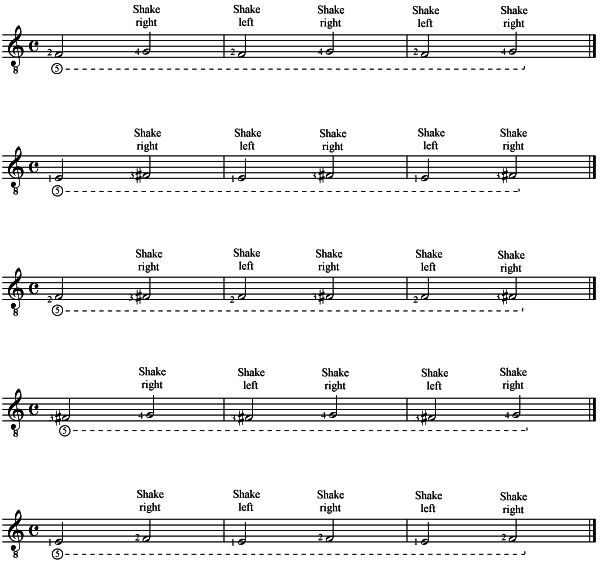
Then try a chromatic scale:

Now, try it on an actual melody. This may seem dumb, but try playing Twinkle Twinkle Little Star with continuous vibrato in 6th position, beginning with your 2nd finger on E on the 5th string 7th fret:
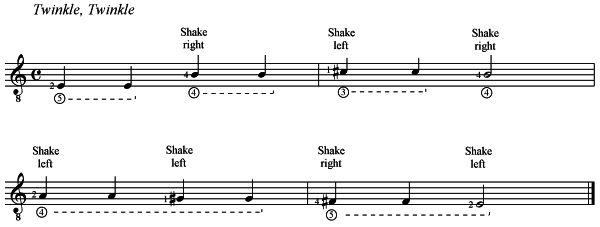
Watch as I demonstrate how I control the direction of the initial hand shake as I change from note to note (video clip #3):
This technique can be applied to any melody.
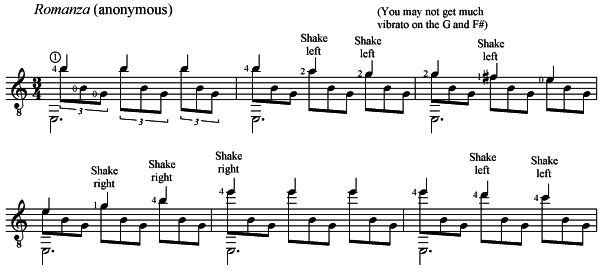
Romanza (or Romance, Romance de Amor, Spanish Ballad) is a commonly played piece that has some good passages in the opening section for practicing vibrato (later passages are also excellent practice but involve holding more difficult chords):
Here is a good example of vibrato movements in Prelude No. 3 by Heitor Villa-Lobos:
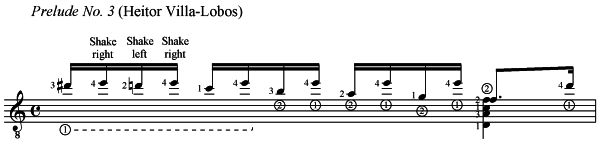
Watch as I demonstrate how to maintain a continuous vibrato on these two pieces (video clip #4):
IMPORTANT: One word of caution. Just because you develop the ability to do a continuous vibrato does not mean you use it all the time! You will stop your vibrato on purpose here and there, sometimes quite frequently. But, when the passage demands it, you will be able to produce an uninterrupted vibrato, producing a gorgeous legato, cantabile line.
Longitudinal Vibrato on Intervals and Chords
Use all the same techniques discussed in Part 1 of this article for longitudinal vibrato of intervals and chords. You may have to press harder to keep the fingers from sliding on the strings. You will also have to be a little more vigilant to ensure your hand shakes maintain strict longitudinal motion. Watch the head of your guitar. If it starts bouncing around, it is an indication that transversal movements are creeping into your vibrato.
It is just as important to learn to maintain continuous vibrato on chords and interval changes as it is on single melody lines. Use the same method you use on single-note lines to determine which direction you are going to shake first. The goal is to keep the hand in uninterrupted motion at the interval or chord change. In a nutshell, if you are shifting up the neck, shake right. If you are shifting down the neck, shake left:

If you are staying in the same position, but the top note of the chord or interval is moving to a higher pitched note, shake right. Shake left if the top note of the chord or interval is moving to a lower pitched note:

Watch as I demonstrate the technique on interval changes (video clip #5):
Here is how this technique can be applied to traditional repertoire:
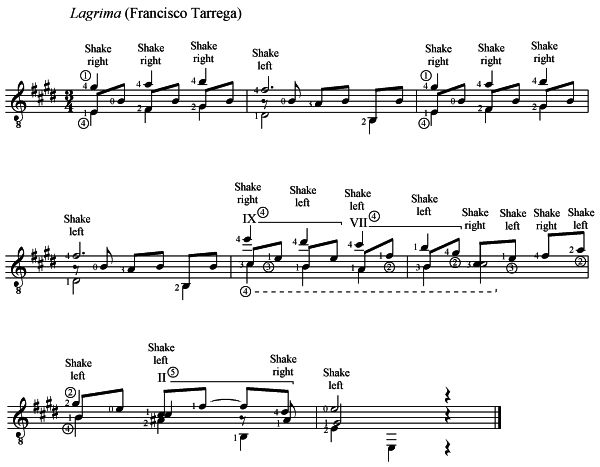
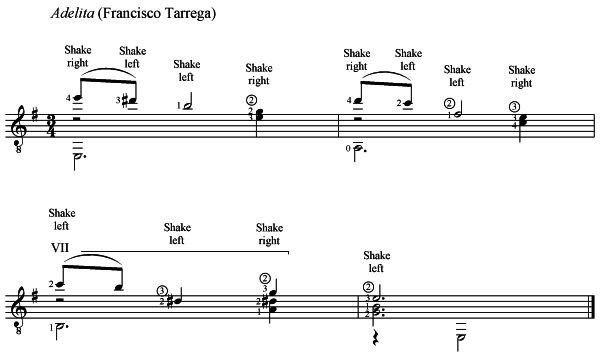
Watch as I demonstrate the technique on L�grima (video clip #6):
Some believe it is easier to vibrato intervals and chords without the thumb on the neck. As I mentioned before in Part 1, personally I can vibrato just as easily with the thumb lightly on the neck, which has the additional benefit of helping to keep the forearm relaxed. Taking the thumb off the neck tends to result in tensing the forearm muscles.
Interesting Considerations
Special note from webmaster: Readers, this is stuff that only Doug would care about. Skip to next section if you like--life is short!
Now come on. I think this is interesting.
Should a vibrato "circle" the mean note going sharp above and flat below; or should it go only on the flat side below the mean note; or should it go only on the sharp side above the mean note? I know. You are already riveted to your seats.
Most singers "circle" the note. As I described above in Part 1, to me a true vibrato starts with the mean pitch, goes above or below the mean pitch, returns to the mean pitch, goes the opposite direction below or above the mean pitch, and finally returns. This is what Leopold Mozart describes in his tome A Treatise on the Fundamental Principles of Violin Playing. Carlevaro diagrams the same type.
Lutenists seemed to have used this vibrato too. A gentleman by the name of Basset writing in Marin Mersenne's Harmonie universelle of 1636 calls the lute vibrato verre casse and tells us it is produced by moving the left hand violently while holding down the string. He advises the player to disengage the thumb from the neck to give more freedom to the hand swing. Thomas Mace, writing in 1676 about the French lute school, calls the vibrato a "sting" and directs the player to "Hold your finger (but not too hard) stopt upon the Place (letting your thumb loose) & wave your hand." Mary Burwell, also a part of the French lute school, writes in 1670 that the "sting" is "made by stopping the little finger upon a string and swinging the hand upon it." These descriptions sound to me like a basic description of the longitudinal vibrato on the guitar. The swinging and waving movements described would probably result in "circling" the mean pitch.
On the other hand, gambists (players of the viola da gamba or gamba--think of it as a cello with frets) had two types of vibrato one of which used two fingers and began at the mean pitch and only went sharp. Pierre Baillot in The Art of the Violin (1835) illustrates the same "sharp-side" vibrato.
On yet another hand (haven't we run out of hands?), French flutist Jacques Hotteterre (in 1707) describes a vibrato he calls the flattement (meaning "flattering") or tremblement mineur which produces a "flat-side" vibrato. He describes the technique and goes on to say that when circumstances prevent using it as described, simply shake the flute to imitate the effect!
Music critic David Hurwitz, in a comprehensive 200+ page article on vibrato for the Classics Today website (http://classicstoday.com) writes, "In modern practice the variation from true pitch is generally lower, on the flat side of the note, and seldom higher, or sharp. This is because the ear invariably identifies the uppermost tone heard as the fundamental pitch, so too high is always a bad thing, at least to our ears."
But Gerhard Mantel in Cello Technique (1972) asserts:
"From an evenly vibrating tone the ear chooses a medium frequency as the main pitch impression. Thus, the tone that the listener hears is exactly in the middle between the extreme pitches of the vibrato...It is wrong to think that the tone perceived is situated at the lower or upper end of the vibrato range."
What's the bottom line? I'm going with "circling" the mean pitch sharp and flat. It is natural to the longitudinal technique, closely resembles the vocal vibrato, and doesn't cause problems of perceived pitch accuracy.
Does it matter which way you shake first? I don't think so. I think fluency is the most important thing. Using my technique of choosing which way to shake first ensures fluency and constant, smooth, natural vibrato. The ear's ability to find the geometric middle of a frequency oscillation (at least according to Mantel) neutralizes any potential pitch accuracy issues.
And now ladies and gentlemen, a feat rarely seen or heard... Vibrato on an open string
Leopold Mozart wasn't wild about solo violin pieces and passages being played using open strings. "He who plays a solo does well if he allows the open strings to be heard but rarely or not at all...the open strings are too loud compared with stopped notes, and pierce the ear too sharply."
The same is true of the guitar. To maintain an even tone quality from note to note, it is best to stay on one string as much as possible and avoid open strings altogether on an exposed melodic phrase. But sometimes you have to use an open string on a cantabile passage. What can you do to make an open-string note blend better with the rest of the closed notes around it? Why not vibrato it? And no, I'm not talking about playing a note and then pulling back repeatedly on the neck. I don't recommend it--not that you will hurt your guitar. It is distracting and will usually generate laughter from your audience which may not be what you're after on the final note of a phrase of a beautiful melody or piece. Nor am I speaking of shaking the instrument--although as already discussed, French flutist Jacques Hotteterre (in 1707) recommended shaking the flute to imitate the flattement vibrato.
There is a technique called the indirect vibrato used by string players that can be used to vibrato an open string on the guitar. Play the 1st string open. There is of course, no vibrato. Now, fret the E on the 3rd string at the 9th fret. Play the 1st string open E and then vibrato the 3rd string E (don't pluck it, just vibrato it). Voila! The open E sounds like it is being vibratoed. Now hold the E on the 5th string at the 7th fret. Pluck the 1st string open E. Vibrato (don't pluck) the 5th string E. Again, it produces the effect of the 1st string open E being vibratoed.
Watch me demonstrate this interesting technique (video clip #7):
This works well with the first four open strings on most guitars. Fret the same note as the open string, either the unison or octave lower (it usually works best from the 5th fret on up), play the open string, and then vibrato the held note. Make sure the held note is perfectly in tune with the open string. The 6th string and oftentimes the 5th requires you to hold the E or A an octave above the open string. In those instances, the technique doesn't produce as strong an effect.
Here is a table of some of the open string indirect vibratos:
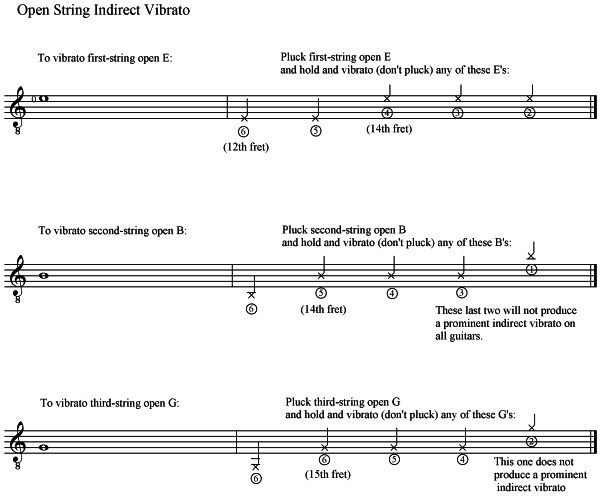
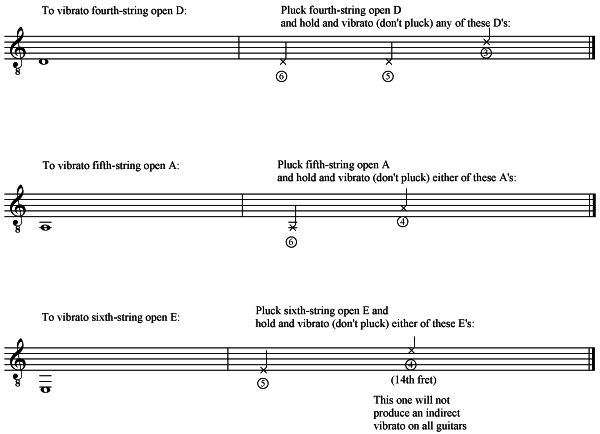
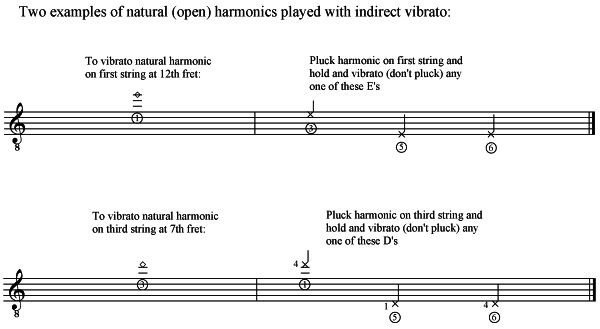
The indirect vibrato technique can also be used to vibrato natural harmonics. As, or after, you pluck the natural harmonic, fret the same note-name as the natural harmonic. I say note-name because it doesn't have to be the same exact pitch. It can and usually will be an octave or two lower. Vibratoing the held note will make the harmonic "shimmer."
Watch video clip #8:
Here are some written examples of the execution of harmonics played with indirect vibrato:
If you are playing two or more natural harmonics simultaneously, you can fret the same note-name of any of the natural harmonics you are sounding. Pluck the harmonics and vibrato the note and all the harmonics will "shimmer." Here is an example from Heitor Villa-Lobos' Choros Typico No. 1:
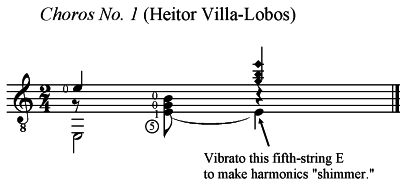
Watch as I demonstrate in video clip #9:
The problem with the indirect vibrato is that its use is generally limited to longer notes where you have the opportunity and time to physically reach and hold the fretted note in the midst of playing other notes.
Vibrato and Your Guitar Strings
The strings you use affect your vibrato. And of course, different guitars respond differently to different strings. In my case, I used to use Aranjuez strings on my 1972 Jose Ramirez. They are great strings. For me, their main asset was their power. For live concerts, I could play on them very hard when necessary and get lots of volume. But I noticed I wasn't getting the silky, warm, singing, shimmering sound I wanted out of my treble strings in the 7th-12th fret sector. I realized that the Aranjuez strings are very high tension (and pretty thick gauge) and that my difficulty with getting the sound I wanted was that the string tension was so high, I couldn't easily stretch and slacken the strings to produce a good longitudinal vibrato. Strings such as Augustine Regals and Savarez 540J are lower tension strings and are also a much thinner gauge and therefore very easily vibratoed. I eventually switched over completely to the Savarez 540J strings.
So, when choosing strings, be sure to include their response to vibrato among all the other factors you consider.
Notation of Vibrato
For the most, part vibrato is part of the basic sound canvas of most singers and instrumentalists capable of producing it. It has been so for centuries. It has almost always been a given that it would be used. (This will be discussed in more detail in a later section of this article.) Therefore, when vibrato is specifically notated in the score, it does not mean use vibrato here and nowhere else. Rather, it is a notation of emphasis--be absolutely certain you use vibrato here; use more vibrato in addition to what you usually use; don't lose your natural vibrato. In addition to other evidence I will discuss later, we can intuit the preceding is the case by the simple fact that after an indication for vibrato is notated; rarely do we see an instruction to return to non-vibrato, normale, natural, etc. In some cases, an indication to use vibrato may also be notated if a previous instruction required the performer to cease his vibrato--in other words, the meaning is to now resume with normal vibrato.
Several theorists have graphically depicted the vibrato following the lead of Christopher Simpson, who in 1659 cleverly indicated its character by notating it as a series of noteheads within the confines of one space on the staff:

Historically, there have been numerous notational marks for vibrato. Here are several:
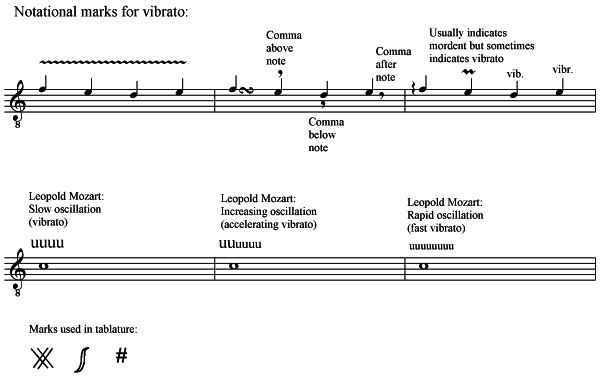
I want to emphasize that overall, vibrato is seldom indicated, for it is assumed to be part of the natural sound of one's voice or instrument. It is left to the discretion and judgment of the performer as to how much to use or how much to emphasize it. I will write about when and how to use vibrato in a later section of this article.
END OF PART 2
Doug isn't finished yet.
Still To Come in Douglas Niedt's Vibrato Trilogy: The Final Installment!
- THE ENTIRE SUBJECT OF TRANSVERSAL VIBRATO.
- How and when to use vibrato--techniques and historical considerations.
- Relating to #2, how to deal with THE HIPPLIFS (the members of the Historically-Informed Performance Practice Lunatic Fringe.)
PDFs and Video Downloads
You may download a PDF version of this technique tip.
Download Whole Lot of Shakin' Goin' On, Vibrato Part 2
Note: You must have Adobe Reader 10 or later installed on your computer to play the videos contained in the PDFs. Download Adobe Reader here.