STRING SQUEAKS AND ROMEO & JULIET
By Douglas Niedt
Copyright Douglas Niedt. All Rights Reserved. This article may be reprinted, but please be considerate and give credit to Douglas Niedt.
String squeaks — the noise a left-hand finger makes sliding along a wound bass string — are extraneous, nonmusical sounds that can spoil a performance. This guide tests the folk remedies (oils, powders, fingertip tricks) and gives the three surefire cures: polished bass strings, fingerings that eliminate shifts on the bass strings, and lifting the finger vertically off the string before you shift.
HERE ARE FOUR WAYS TO ELIMINATE OR REDUCE STRING SQUEAKS, FINGER SQUEAKS, FINGER NOISE, STRING NOISE
1. Change the left-hand fingering to avoid shifts to eliminate or reduce string noise, string squeaks, finger noise, and finger squeaks. Most string noises, string squeaks, finger noises, and finger squeaks originate from left-hand finger movement on the wound bass strings. Choose a different left-hand fingering to eliminate or reduce string squeaks, finger squeaks, finger noise, and string noise. Oftentimes, changing the left-hand fingering is the easiest way to get rid of string squeaks, finger squeaks, finger noises, and string noises. Shifts on the wound bass strings cause string noise, string squeaks, finger noise, and finger squeaks. Choose fingerings that eliminate shifts on the wound bass strings.
2. Change the left-hand fingering so that you STRETCH from note to note instead of shifting to eliminate string noise, string squeaks, finger noise, and finger squeaks.
3. Lift the left-hand fingers vertically or perpendicularly off the wound bass strings to eliminate or reduce string noise, string squeaks, finger noise, and finger squeaks.
Correctly lifting a finger from a wound string during a shift (rather than sliding) eliminates the string squeak every time it is tried. Lift the finger off the string BEFORE the shift. However, you must lift vertically off the string. Some guitarists describe it as a “helicopter” lift:
- Vertical takeoff: Lift the finger absolutely vertically off the string.
- Fly horizontally or in a slight arc: Shift to the new fret destination.
- Vertical landing: Place the finger absolutely vertically back onto the string.
But there is a tricky nuance to the technique. The finger must be lifted off and placed on the string at a 90-degree angle. Otherwise, the finger will scrape a coil or winding of the string (which is what causes the squeak). Here is how to do it: I call it "fake left, go right." Basically, you are overcompensating in the opposite direction and before the fact. If you are shifting up the neck (to the right), begin the shift by coming off the string to the left (when shifting down the neck, come off the string to the right). By experimenting with varying degrees of exaggeration, you will be able to find a point where you can eliminate the squeak without compromising the notes on either end of the shift. It may take some time and experimentation, but it really does work.
4. Using polished bass strings cuts down tremendously on string noise, string squeaks, finger noise, and finger squeaks. The polishing process flattens and smoothes the windings of the bass strings, tremendously reducing the friction that causes string squeaks and other finger noises. The downside is that polished bass strings sound different than regular strings. Most people would describe them as having a slightly dull sound. Others say they don’t have enough projection or clarity.
5. You can NOT get rid of string squeaks on the bass strings if you do a glissando. Other than using polished bass strings, it is pretty much impossible to eliminate a string squeak when performing a glissando.
MORE IDEAS. Some that work and some that don't.
Playing for other people can be a sobering experience. Guys, have you ever played for a girl you wanted to impress? Guys or gals, have you played for family or friends? Maybe you're thinking about playing for someone. You've spent a lot of time on a piece and think, "You know I've worked really hard on this and I think it sounds pretty darn good. I think they will like it a lot." Or maybe you want to play for your spouse to get their opinion of your work, hoping for some appreciation or recognition.
So you put yourself on the line and play your heart out. You finish, thinking, "That was good. He (she) will really like that." You look at them, awaiting their approval, their approbation, their laudatory comments. Their eyes meet yours and your spouse, potential lover, friend, mother, father, sister, brother says, "Oh, hey that was pretty good. So, what are those string squeaks?"
Kind of like the late opera soprano Beverly Sills singing her heart out in a passionate aria and then being asked, "So, why did you choose that shade of lipstick?"
String Squeaks Matter—Just Ask Juliet
Let me first say: string squeaks matter. They are extraneous nonmusical sounds and can spoil a performance. They are on the same level as Romeo passing gas while passionately kissing his Juliet. They can ruin the moment!
Unfortunately, there are a number of guitarists out there who say squeaks don't matter. They say that squeaks are just part of the instrument, an acceptable part of the performance. Squeaks are natural. Some people on the Internet think, "They're cool." I'm not kidding. If you are one of those, quit reading right now. I'm sure you're a nice person and your mother loves you, but we live in different universes. I don't think it will do either of us any good to argue the point.
Many guitarists don't notice squeaks because they are so used to hearing them in their own playing and in others' playing, both live and on recordings. They simply ignore the squeaks and their brain learns to not hear them. It becomes a type of selective hearing.
When other instrumentalists hear guitarists, they are appalled at the string squeaks we make. They often ask, "Are those normal?" Or they may ask if the guitarist is making the squeaks because his technique is faulty. They also comment on how obtrusive the finger squeaks are on the music.
Doug's Wake-up Call from a "Juliet" in California
Guitarists forget how nonmusical and disturbing finger squeaks can be, especially to an audience of non-guitarists. I will never forget my own personal wake-up call on finger squeaks. I gave a concert in Sacramento, California a number of years ago. It went very well and I was receiving well-wishers afterward. A potential Juliet came up to me and told me how moved she was by my music and how wonderful the sound was. "But," she asked, "What were those squeaks? Were those mistakes?"
Her words hit me like a brick. My reaction in the first hundredth second or so was, "How foolish. How could she possibly think they were mistakes?" But very quickly in the second hundredth of a second, I realized she had never been to a classical guitar recital and that even though she loved the music and the sound of the guitar, she knew the squeaks were sounds that didn't belong. They must have been as jarring to her as her words about them were to me. As beautiful as the music was, the string squeaks ruined the moment for her.
I could have dismissed her as an oddball, but I caught myself and reminded myself of Doug's Rule of Life #17: if one person thinks something, there are hundreds or thousands of other people who think the same thing, however wrong I may think it to be.
Most of the members of my audiences are NOT guitarists and therefore are not going to accept finger squeaks as a natural part of the music. The last thing I want is for my listeners to be distracted from the magic of the guitar and its music by non-musical sounds such as finger squeaks, or to think they are mistakes.
As most guitarists know, squeaks are notoriously difficult to eradicate from one's playing, at least for me. Am I obsessed by a quest to eliminate every finger squeak from my playing? Do I lie awake nights wondering how I can eliminate the squeaks from measure number x of piece y? Of course not. We don't have to be manic about string squeaks, but I think we certainly need to minimize them wherever possible.
SNAKE OIL OR CURES? These don't work for me.
The following cures for finger squeaks do NOT work for me. They may work for you—try them and see. Everyone's skin and touch is different.
Oils
1. Some people say a thin coating of Wesson oil, or olive oil on the strings works wonders to eliminate finger squeaks. If you played electric guitar in the 60s, you may remember Finger Ease. Not many people report success with Finger Ease for eliminating string squeaks—they say the thicker vegetable oils last longer and are more effective. Players report no decrease in the sonic life of the strings. One person recommended bacon grease. I think he was kidding. I
hope so.
2. Some players swear by the natural oils from the surface areas of the nose, forehead, behind the ear, or scalp. They "oil up" by rubbing the areas with the finger tips and claim it eliminates string squeaks.
None of the above work for me. But I do love bacon.
Powder
Others go with powder. Try straight corn starch or baby powder with cornstarch—NOT talc. Talc powder can get into your lungs and trigger coughing—the last thing you need before a performance.
Again, this doesn't work for me to eliminate string squeaks. It DOES work to eliminate sticky, sweaty, or clammy hands. The down side of powder is that it gunks up the strings and dulls the bass strings after a couple hours. But you can clean them (at full tension) with a washcloth dampened with water (then dry the strings immediately) to bring them back to life and extend their playability a few days. Powder can also get all over your clothes (it shows badly if you are wearing concert-black clothing).
Using Different Parts of the Fingertip
Many people recommend staying off the callused fingertip which is the hardest, driest part of the finger. Some recommend filing the callused area with a nail file (doesn't work for me—maybe because my fingertips seem to be callused down to the bone). Others say to soak the last quarter inch of the fingertips in warm water for ten minutes and then dry them completely with a hair dryer (about 30 seconds) before a performance. If they get sticky, try some powder. That one also didn't work for me.
1. A common recommendation is to slide on the flat non-callused part of the finger pad, well away from the tip. Sometimes this is only useable when the adjacent higher-pitched string is not being played. Try different angles of placement of the finger. Again, this one doesn't work for me.
2. Another method is to slide on either side of the fingertip. Try placing the finger leaning to the left and try it leaning to the right to see if one angle works better than the other. Once again, none of this works for me.
3. Some players swear by the idea of avoiding sudden takeoffs and landings and by sheer finesse and pushing harder (or according to others, less!) into the string as they shift, assert they are able to eliminate all string squeaks. Guitar great Narciso Yepes once told me about the technique of pressing harder as the finger slides, but I could never get it to work.
THINGS THAT WORK FOR ME TO ELIMINATE STRING SQUEAKS. Romeos and Juliets, listen up:
Strings
New strings definitely squeak more than old. But allowing strings to become dull sounding is not exactly a desirable way to eliminate string squeaks. By the way, be sure to practice the techniques mentioned in this article with NEW strings. For most players, old strings produce much less squeaking. Practicing on them will give you a false idea of how much string noise you will get when doing a real performance with new strings.
Using polished bass strings cuts down tremendously on string squeaks. Savarez, La Bella, and D'Addario all make polished bass strings. The polishing process flattens and smoothes the windings of the bass strings, tremendously reducing the friction that causes string squeaks and other finger noises. The down side is that polished bass strings sound different than regular strings. Most people would describe them as having a slightly dull sound. Others say they don't have enough projection or clarity.
In a previous technique article, More Than You Ever Wanted to Know About GUIDE FINGERS, I related a story about guitarist John Williams. Let me quote it here again:
I was speaking with John Williams after his concert in St. Louis a few years ago. He was very excited about the strings he was using: D'Addario Pro Arte Composites Lightly Polished EJ45LP-normal tension (you can order the basses separately). He explained that the basses were lightly polished and that he could now play things like the fast middle section of Villa-Lobos' Prelude No. 4 without having to lift his fingers off the strings and that there were no string noises. He played a passage to show me. He said he much preferred to leave his fingers down on the strings to produce perfectly legato (smooth, connected) shifts. He said that in the past, when he used other strings, he would lift his fingers to eliminate the string noises. But lifting his fingers produced an element of disjointedness between the chord changes that he never liked.
The polished basses work for John Williams and he doesn't have a problem with their tone quality. They work well for me too—I especially find them useful for recording.
But a word of warning. Do NOT try to do the polishing yourself with fine sandpaper. Leave it to the professionals. Unless the string is polished absolutely evenly, it will play out of tune. I tried to do it as part of my research to write this article. We even made a video of me polishing a string. When I was done, the string didn't squeak but its intonation was terrible. It doesn't work.
Choose a Different Fingering
Many times, just using a different fingering eliminates string squeaks. Here are a few ways we could finger one of the squeaky phrases in the middle section of Leyenda (Isaac Albéniz):
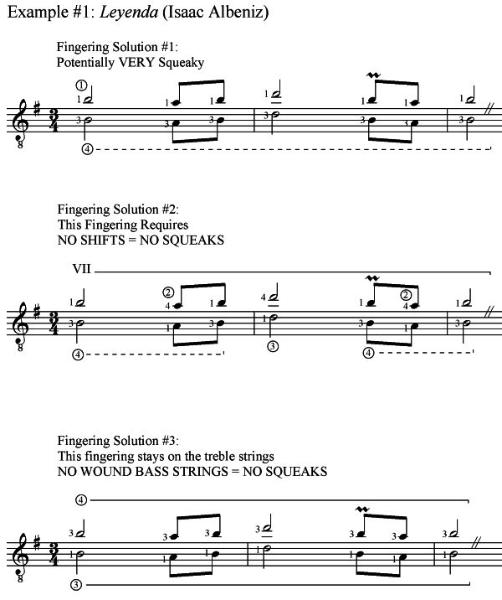
Even though fingering solutions #2 and #3 will eliminate the squeaks, the down side is that you simply may not like the sound of an alternate fingering. But many times you can still use a fingering that you prefer (even if it is potentially squeaky) and by using different types of guide fingers or using them in different ways, eliminate or tone down the squeaks. Refer to my article on Guide Fingers for information on these techniques.
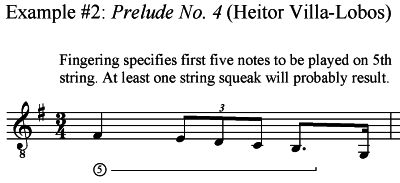
In the following example from Villa-Lobos' Prelude #4, the first five notes are specified to be played on the 5th string. Whatever left-hand fingering you use will probably result in at least one string squeak.
We can finger the passage in various ways to eliminate shifting on the bass strings, thus eliminating string squeaks:
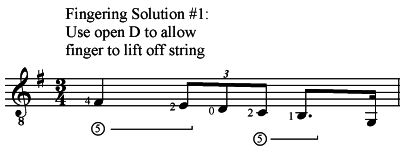
Some may say it is sacrilege to change Villa-Lobos' fingering. Yes, the ideal thing would be to keep all the notes on the 5th string, maintaining an even tone quality on the melody. But in this and other similar instances, I would rather put up with the change of tone quality than have the beauty of the music jarred and my listeners' ears assaulted by a string squeak. Remember Romeo and Juliet. You don't want to ruin the moment.
When you are contemplating changing to a different fingering, the simple question you must ask yourself is this: is the overall effect better if I use the old fingering with the string squeak, or better if I use a different fingering that eliminates the squeak? Which preserves the mood of the music best? Which is less intrusive or noticeable to the listener? You must face up to the fact that normal considerations such as evenness of tone quality, ease of playing, security, logic, or "that's the way I've always done it" may have to fall by the wayside for the greater good of not ruining the moment with a string squeak.
Lifting Fingers to Avoid String Squeaks
Correctly lifting a finger from a wound string during a shift (rather than sliding) eliminates the string squeak every time it is tried. The key word is "correctly." The down side of the technique is that you will have dead space between the notes during the shift. When done well it will not sound obviously choppy, but as John Williams said to me, this kind of movement is never as smooth as keeping the finger tightly on the string and sliding.
Abel Carlevaro, the great Uruguayan guitarist, composer, and pedagogue doesn't much like guide fingers at all. He recommends that the guitarist always lift the finger from the string before the shift. He says that before the shift, the fingers must "abandon" the strings. They withdraw their pressure from the string, allowing themselves to be lifted perpendicularly off the strings. After being lifted, they enter into a momentary state of relaxation, before being transported by the arm to their new fret. Carlevaro strongly emphasizes that the perpendicular lift off the string is nearly imperceptible to the eye.
Carlevaro's focus is to execute shifts with maximum accuracy and minimal effort. But an interesting side benefit of his shifting technique is that it eliminates string squeaks and other shifting noise, especially on the wound bass strings. When the fingers are lifted perpendicularly off the strings, friction is eliminated. Therefore, no noise is produced.
Others describe the movement as a helicopter movement:
1. Vertical takeoff: Lift the finger absolutely vertically off the string.
2. Fly horizontally or in a slight arc: Shift to the new fret destination.
3. Vertical landing: Place the finger absolutely vertically back on to the string.
But there is a tricky nuance to the technique. The finger must be lifted off and placed on the string at a 90-degree angle. Otherwise, the finger will scrape a coil or winding of the string (which is what causes the squeak). In a Google guitar-group discussion Thomas, a guitar teacher in Tampa, describes it very well:
I call it "fake left, go right." Basically, you are overcompensating in the opposite direction and before the fact. If you are shifting up the neck (to the right), begin the shift by coming off the string to the left (when shifting down the neck, come off the string to the right). By experimenting with varying degrees of exaggeration, you will be able to find a point where you can eliminate the squeak without compromising the notes on either end of the shift. It may take some time and experimentation, but it really does work.
Watch me demonstrate the technique in this stunning video clip. This clip is sure to be a serious contender at the Cannes Film Festival this season.
But what do you do if the musical score indicates a glissando on a wound bass string such as in the opening of Villa-Lobos' Prelude #1:
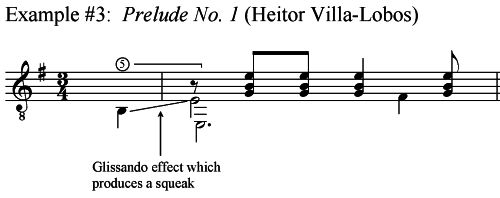
1. You could eliminate the glissando (and probably all the others indicated in the piece). Lift the finger and then shift rather than sliding. Or, refinger it. Play the opening B on the 6th string instead of the 5th with no glissando or shift. Eliminating the glissandi will markedly change the feel and character of the piece. Some would like the squeak-free and glissando-free sound, but
many would hate it.
Incidentally, as I pointed out in my article about guide fingers, people often use the words glissando and portamento interchangeably or even incorrectly. A portamento can be thought of as a "slide" of infinite pitches while a glissando consists of individual notes being sounded out however quickly the glissando is executed. Therefore, a violin produces portamento when the player moves his bow on the string and slides his finger smoothly up or down the fingerboard. The guitar, piano, and pitched mallet instruments are not capable of producing portamento. The piano sounds each individual note as the player glides a finger across the keys. A similar thing happens when a guitarist plucks a note and then slides the finger up or down the string. The finger "defines" each individual chromatic pitch as it slides up or down the fretboard. That is a glissando, not a portamento.
2. Play the glissando, but use one of the techniques mentioned earlier in this article to eliminate the squeak. Maybe one of them will work for you. But I would stay away from the bacon grease.
3. Use polished bass strings.
The Conclusion
The three surefire ways to eliminate or lessen string squeaks
1. Use polished bass strings
2. Change the fingering to eliminate squeaky shifts
3. Lift when you shift.
Remember, you can NOT get rid of string squeaks on the bass strings if you do a glissando. Other than using polished bass strings, it is pretty much impossible to eliminate a string squeak when performing a glissando.
It's worth trying the other methods mentioned earlier in this article too—you never know, they just might work for you.
However you choose to do it, whether playing your guitar or kissing your Juliet (or ladies, kissing your Romeo); do it with finesse—don't ruin the moment with rude noises.

PDFs and Video Downloads
You may download a PDF version of this technique tip. Download String Squeaks and Romeo & Juliet
Guitar Technique Tips
Your Personal Guitar Lesson

"Douglas who?"
Douglas Niedt is a successful concert and recording artist and highly respected master classical guitar teacher with 50 years of teaching experience. He is Associate Professor of Music (retired), at the Conservatory of Music and Dance, University of Missouri-Kansas City and a Fellow of the Henry W. Bloch School of Management—Regnier Institute for Entrepreneurship and Innovation.
Doug studied with such diverse masters as Andrés Segovia, Pepe Romero, Christopher Parkening, Narciso Yepes, Oscar Ghiglia, and Jorge Morel. Therefore, Doug provides solutions for you from a variety of perspectives and schools of thought.
He gives accurate, reliable advice that has been tested in performance on the concert stage that will work for you at home.
PURCHASE AN ALL-ACCESS PASS
TO THE VAULT OF CLASSICAL GUITAR TECHNIQUE TIPS

"Hello Mr Niedt,
My name's Gretchen, and I'm so happy I purchased an All-Access Pass to the Vault. I love your awesome technique tips. I'm amazed how much I have improved my playing.
Thank you!"
ARE YOU LOOKING FOR PROVEN STRATEGIES
THAT WILL MAKE YOU A BETTER GUITARIST?
Check out the game-changing tips in my Vault—I promise they will kick your playing up to the next level.
Purchase an All-Access Pass to the Vault.
It's a one-time purchase of only $36!
You receive full access to:
- Over 180 technique tips in The Vault.
- Special arrangements of Christmas music
- Arrangement of the beautiful Celtic song, Skellig
- Comprehensive guide, How to Master the Classical Guitar Tremolo
All that for a one-time payment of only $36. Take me to the page to Purchase an All-Access Pass

Contact Me
Do you have a question?
Comment?
Suggestion for the website?