Guitar Technique Tip of the Month
Your Personal Guitar Lesson


Contact Me
Do you have a question?
Comment?
Suggestion for the website?

Download the PDF
You may download a PDF version of this technique tip.
Download Stretching Exercises
Note: You must have Adobe Reader 10 or later installed on your computer to play the videos contained in the PDFs. Download Adobe Reader here.
STRETCHING EXERCISES
By Douglas Niedt
Copyright Douglas Niedt. All Rights Reserved. This article may be reprinted, but please be considerate and give credit to Douglas Niedt.

The stretching exercises presented in this Technique Tip of the Month are designed to make it easier to reach large spread out intervals or chords on the fingerboard�reach development exercises as they are called in Aaron Shearer�s booklet titled Slur, Ornament, and Reach Development Exercises.
Although long fingers are certainly not a requirement for being a good guitarist, stretching exercises of this type will definitely make life easier for the player with short or stiff fingers. Even for the player with large hands, stretching exercises make playing more effortless and thus more relaxed and accurate.
DO NOT DO STRETCHING EXERCISES AS PART OF YOUR WARMUP. Hard research on this topic is sparse. What little research that is available in the music field and sports medicine shows that stretching produces no significant positive effects and indeed may have negative effects. AFTER you have warmed up, the careful practice of stretching exercises is beneficial to learning specific pieces and passages. The key words are �careful practice�. Any stretching exercise or movement has the potential to cause injury.
The exercises in this article should be practiced only after you have been playing 15-30 minutes. These exercises should be practiced slowly and gently (don�t be aggressive). The notes are written as whole notes to emphasize that each position of the fingers should be held for several seconds to allow the muscles to stretch. Quick, jerky movements can do more harm than good, especially if you are prone to hand problems. Remember, slowly and gently.
And remember that exercise programs of any sort for any part of the body are of no use if you don�t execute them on a regular basis over a long period of time. If you do these exercises every day, you will certainly see results in 45 days. If you only do them a couple days a week, or stop after two weeks, you have wasted your time. Fortunately you will not have wasted any money on this, unlike that treadmill, rowing machine, stationary bicycle, StairMaster, (insert name of exercise machine here) that is collecting dust in the garage, basement, or attic!
Stretch Between the 1st and 2nd Fingers
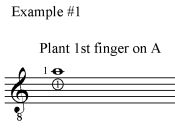
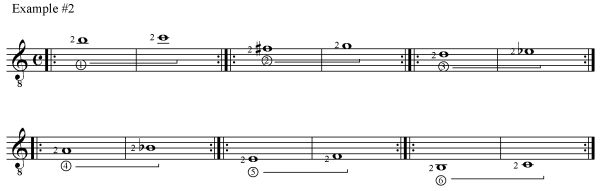
Holding the first finger on the A on the first string, fifth fret (see Example #1 above); play each pair of the measures in Example #2 (below) two or three times. If these are too difficult, try stretching from just the 6th to 7th fret first. If you are limber, feel free to stretch even higher with the second finger, i.e. instead of playing the 7th to 8th fret indicated below, try the 8th to 9th fret. But don't lift the first finger off the first-string A and don't distort your hand position. And remember, it should NEVER hurt:
Stretch Between the 1st and 3rd Fingers
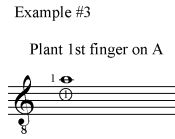
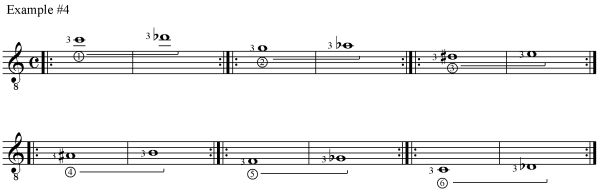
Holding the first finger on the A on the first string, fifth fret (see Example #3 above); play each pair of the measures in Example #4 (below) two or three times.
If these are too difficult, try stretching from just the 7th to the 8th fret first. If you are limber, feel free to stretch even higher with the third finger, i.e. instead of playing the 8th to 9th fret indicated below, try the 9th to 10th fret. But don't lift the first finger off the first-string A and don't distort your hand position. And remember, it should NEVER hurt:
Stretch Between the 1st and 4th Fingers
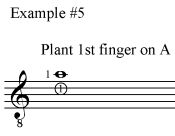
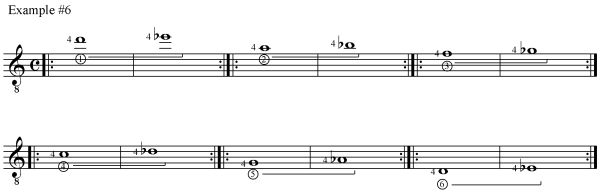
Holding the first finger on the A on the first string, fifth fret (see Example #5 above); play each pair of the measures in Example #6 (below) two or three times.
If these are too difficult, try stretching from just the 8th to the 9th fret first. If you are limber, feel free to stretch even higher with the fourth finger, i.e. instead of playing the 10th to 11th fret indicated above, try the 11th to 12th fret. But don't lift the first finger off the first-string A and don't distort your hand position. And remember, it should NEVER hurt:
Stretch Between the 2nd and 3rd Fingers
Stretching between the second and third fingers is difficult. In this combination, instead of planting at the 5th fret as in the previous examples, you may need to start with the 1st and 2nd fingers planted higher up on the first string where the frets are slightly closer together, in order to stretch just one fret:
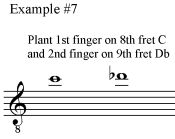
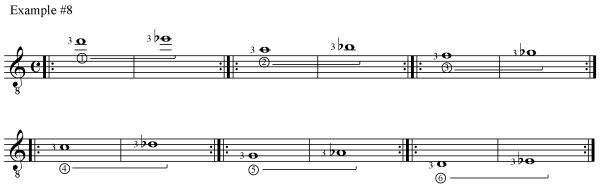
Holding the first finger on the C and the 2nd finger on the Db (see above), play each pair of measures in Example #8 (below) two or more times. Remember, this should NEVER hurt:
Stretch Between the 2nd and 4th Fingers
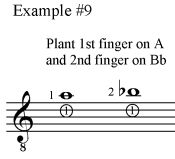
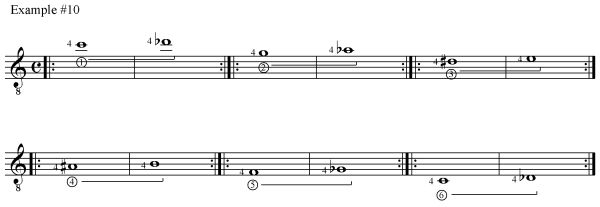
Holding the first finger on the A and the 2nd finger on the Bb (see above), play each pair of measures in Example #10 (below) two or more times.
Feel free to stretch even higher with the fourth finger, i.e. instead of playing the 8th to 9th fret indicated here, try the 9th to 10th fret. But don't lift the first and second fingers off the first string A and Bb and don't distort your hand position. And remember, it should NEVER hurt:
Stretch Between the 3rd and 4th Fingers
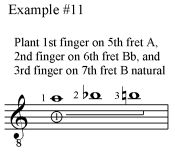
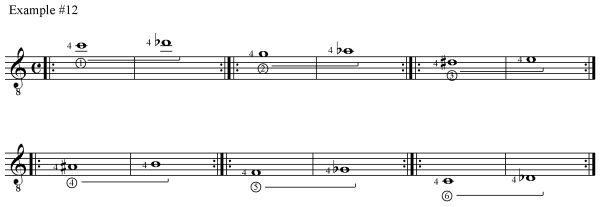
Holding the first finger on the A, second finger on Bb, and third finger on B natural (see above), play each pair of measures in Example #12 (below) two or three times.
Feel free to stretch even higher with the fourth finger, i.e. instead of playing the 8th to 9th fret indicated here, try the 9th to 10th fret. But don't lift the planted first, second and third fingers off the first string and don't distort your hand position. And remember, it should NEVER hurt:
Whole-Tone Scales for Stretching
Whole-Tone Scales for Stretching The whole-tone scale is a simple and very effective tool for practicing stretches:
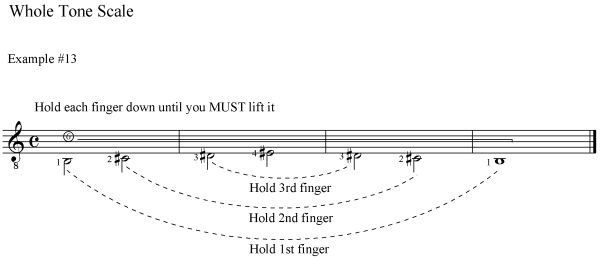
Practice the scale slowly as shown above. Continue descending down the fingerboard one fret at a time:
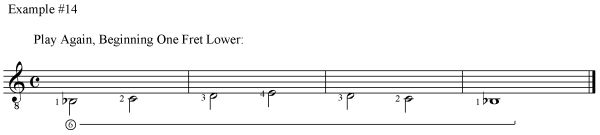
Descend again:
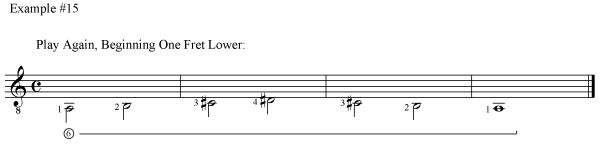
Continue descending until you can't play the notes cleanly. As you descend, the frets get wider and wider apart which will gradually stretch your fingers more and more as you proceed. At first, you may only be able to go down one or two frets. Practice this scale on all six strings. Playing it on the first string feels different from playing it on the sixth string. And remember to keep each finger down until it MUST lift.
Once again, these exercises should NEVER hurt. Play them slowly and don't push your hand to do a stretch it isn't ready to do. Most stretching should feel good.
Download the PDF
You may download a PDF version of this technique tip.
Download Stretching Exercises
Note: You must have Adobe Reader 10 or later installed on your computer to play the videos contained in the PDFs. Download Adobe Reader here.