Thank you for visiting.

GUITAR TECHNIQUE TIP OF THE MONTH
Your Personal Guitar Lesson

Photo by Robin Gentile, NYC

BE SURE TO VISIT DOUG'S "SECRET VAULT"

It contains many of Doug's Previous
Guitar Technique Tips of the Month
Have a comment?
Question?
Suggestion for the website?
We would love to hear from you.
We have a Printer Friendlier (PDF) version of this article that's also easier on the eyes.
It's SO much easier to read a printed article than to read it from the computer screen.


Sight-reading

By Douglas Niedt

Copyright Douglas Niedt, All Rights Reserved. This article may be reprinted, but please be
considerate and give credit to Douglas Niedt.


You are on DouglasNiedt.com

There is an unfortunate joke out there that goes like this:

Question: "How do you get a guitarist to be quiet?"
Answer: "Put a piece of sheet music in front of him."

Yes, it's funny. Yes, it hurts. And it's unfortunate because it's true much of the time. Many
guitarists are poor sight-readers. In a musical world where the guitar is still not always
respected as a "legitimate" instrument, I’m sometimes embarrassed when colleagues who play
other instruments tell me they tried to play chamber music with this or that guitarist (sometimes
well-known guitarists!) but found it frustrating or impossible because the guitarist couldn't read
well enough.

Or, closer to home, I’ve had students at the Conservatory of Music, University of Missouri, who
simply couldn’t keep up with the demands of our guitar program, because it took them half of
the semester to learn the notes and rhythms of their pieces. This left little time to really master
the details and interpretation of the pieces.

You are on DouglasNiedt.com


THE IMPORTANCE OF SIGHT-READING

Most musicians recognize the obvious importance of sight-reading in areas of the profession
such as accompanying, teaching, ensemble playing, and radio, television, and film studio work.
But what about the amateur guitarist, or the guitarist who aspires to be a solo performer? Of
what value is sight-reading to them?


Faster and More Efficient Mastery of Pieces

The ability to sight-read gives a guitarist fluency. It makes the journey of learning a new piece
so much easier and efficient. It shouldn't be a battle to learn the notes and rhythms of a new
piece of music!

It is essential that a guitarist be able to read well enough to begin playing a piece from ANY
point. In every new piece there is always a chord change, a rhythm, a scale, an effect, a new
technique, a difficult measure or part of a measure that requires specialized repetitious
practice.

For example, if the difficulty is changing from chord "x" to chord "y" in the middle of the piece,
the student who can't read well often has to back up several measures to figure out where he
is. If wants to practice the chord change twenty times, imagine the amount of time he wastes
having to also play the several measures leading up to the change (which he may play
perfectly well). If his reading skills were up to par, he would be able to start immediately at the
difficult spot, work the chord change, and not waste time practicing measures he already
knows. In a piece that has many such spots to practice (and that would be the norm), the poor
reader wastes an unbelievable amount of time practicing material that he can already play.

Let's look at the following example from an
Andante by Fernando Sor:

Ex. #1
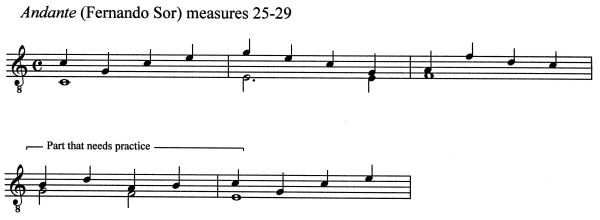


If the part that needs practice is measure twenty-eight into measure twenty-nine, then the
obvious segment to practice is:

Ex. #2
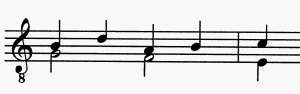


But instead, the unskilled reader will have difficulty figuring out where that spot is and
unfortunately, will start at the beginning of the line!

Imagine a student driver trying to learn to parallel park a car. He finds a place on a street with
an empty parking place. All he really needs to do is practice pulling into the space over and
over until he gets the hang of it. But instead, the automotive version of a bad music sight-
reader decides to drive around the block after each attempt to pull into the parking space. Or
at the extreme, the student driver decides to drive home, park the car in the garage, and then
goes out to find the same parking space and practice pulling into it again. Over and over! The
poor music reader is doing the same thing when he has to back up several measures or more
every time to practice his chord change. Obviously, that’s a very bad waste of time, expense,
and energy.


Good Reading Skill Results in Better Guitar Lessons

In a lesson or master class, if your teacher says, "Let's start here," you need to be able to read
well enough to begin reading from "here" and know exactly where "here" is. Having to back up
to the beginning of a section, line, page, etc. wastes a lot of time, not to mention your money.
Try this: take out a piece of music you are learning. Close your eyes and randomly point to a
spot on the page. Keep your finger on the music, open your eyes, and begin playing from the
spot your finger is pointing at. If you can't play immediately from that point, you have weak
reading skills.

It's hard to over emphasize how much more efficiently you will practice and how much more you
will accomplish in your lessons or a master class if your sight-reading is really good.

You are on DouglasNiedt.com


Good Sight-reading Ability Provides Access to More Music

On another level, good sight-reading skills provide access and familiarity to a wide variety of
literature that we otherwise might not get to know. Yes, we can listen to recordings to hear
unfamiliar literature, but not all the good or interesting literature is recorded. There are
hundreds of brilliant compositions waiting to be discovered. In fact, for the guitarist aspiring to
be a concert performer, it is almost imperative that he find music that has not been recorded to
help establish his own artistic profile and personality. The good sight-reader has an open door
to a broad acquaintance with a wide range of music. Those guitarists interested in transcribing
music will find the ability to sight-read a wonderful gift. It will save time in finding suitable works
to transcribe and make the process of transcription quicker, more accurate, more efficient, and
more enjoyable. It will also open up more creative possibilities and resolutions to technical
problems in the transcription process.


Good Sight-reading Skill Will Enable You to Discover the Meaning of a Piece
Within a Greater Context

Finally, on yet another level, extensive sight-reading will introduce many new technical,
stylistic, and interpretive experiences that will contribute directly to the artistic grasp of the
pieces selected for more formal study. Thanks to this wealth of experience, one may study a
particular fugue or sonata not in isolation, but in relation to the whole literature of fugues or
sonatas.

Vladimir Horowitz, perhaps the greatest pianist of the twentieth century, once said in an
interview:

    "This year I play two pieces of Faure. First of all, I studied the whole composer. I play
    everything he wrote. Ensemble music, everything, I play myself--not listen to recordings.
    Records are not the truth. They are like post cards of a beautiful landscape. You bring
    the post cards home so when you look at them you will remember how beautiful is the
    truth. So I play. I'm a very good sight-reader. The texture of the music talks to me, the
    style. I feel the music, the spiritual content of his compositions."

Yes, feeling the style of the music and the spiritual content can only be experienced by playing
it, not by listening to records. Like Horowitz, I believe the concert guitarist cannot truly feel and
understand the style and content of say, Bach's
Lute Suite No. 4 without also studying, at the
very least, the other three Lute Suites and their alternate versions for unaccompanied violin
and cello.

You are on DouglasNiedt.com


What About Great Musicians Who Can’t Read Music?

Those of you who are reading this article who can also play styles of music other than
classical, may say, "Wait a minute. Some of the greatest jazz, pop or rock musicians can't even
read music, let alone sight-read. But they're great artists. Maybe learning to sight-read isn't
really that important."

My answer is that those artists have a fantastic natural ability to play by ear. We also have to
acknowledge that those styles of music are very different from classical, and are learned and
studied differently too. But my bottom line answer is why not be able to play by ear AND be
able to read well? There are good sight-readers who can't play by ear. That's no good either. I
have also heard it said that reading music stifles the creative ability or hinders learning to play
by ear. That is absolutely untrue. It seems to me the ideal goal is to develop a great ear AND
good sight-reading ability. Have the best of both worlds.

So what is the best way to learn or improve your sight-reading? That's easy: READ, READ,
READ. The prescription for learning to sight-read is to sight-read. One need not practice
reading for hours every day. Just ten minutes daily every day will result in tremendous
improvement in one month.

You are on DouglasNiedt.com


HOW TO DO IT

You Have To Know Your Notes

To start, you should already know the notes on all six strings from the first through the twelfth
fret. Although you could learn the notes as you work on your sight-reading, it's best if you
already know them.

1. First, work vertically, naming the notes on each string from open to the 12th fret and then
backwards. Here is the fourth string:

Ex. #3
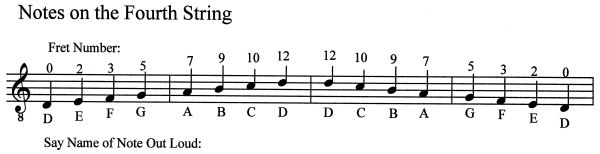


2. On each string, one string at a time, pick frets at random and name the notes. For example,
on the fourth string: Second fret=E. Fifth fret=G. Ninth fret=B. Fourth fret=F#.

3. Then, name a note at random (A, B, C, D, E, F, G) and find the fret where it's located. For
example, again on the fourth string: A=seventh fret. F=third fret. C=tenth fret. B=ninth fret.

4. Next, work horizontally: pick a fret at random and name the notes at that fret from the 6th
string to the 1st string and back to the 6th. Concentrate particularly on the 3rd, 5th, 7th, 8th,
and 10th frets. For instance, the next example shows the notes across the seventh fret:

Ex. #4



5. Find all the octaves and unisons. Name a note at random and find that note on every string
within the first 12 frets. For example, here are all the B's:

Ex. #5



You are on DouglasNiedt.com

6. It's also valuable to write out the notes on manuscript paper. When you do the exercises in
the previous paragraphs, write out the notes! You need to make the connection between
fretboard and paper. Knowing that the fourth string at the seventh fret is an "A" won't improve
your music reading if you don't know where that "A" is on the staff.

To improve your knowledge of the fretboard, also check out the
Guitar Theory Learn the
Guitar Fretboard trainer and Guitar Theory Note Trainer here on my website under Fun Stuff.

After you are secure in your knowledge of the fretboard and where the notes are on the staff,
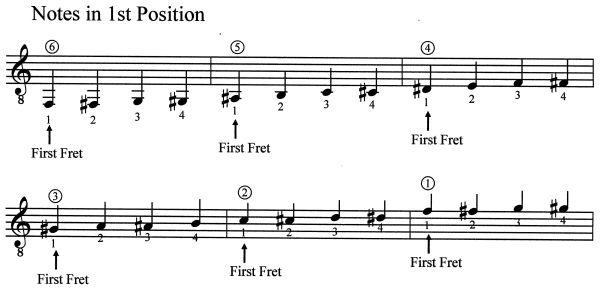
begin by sight-reading fairly elementary single-line melodies. The goal is to be able to read
any single-line melody in any position of the guitar. A position is a four-fret span. The number
of the position is determined by the fret number that the left-hand first finger plays:

Ex. #6


Ex. #7
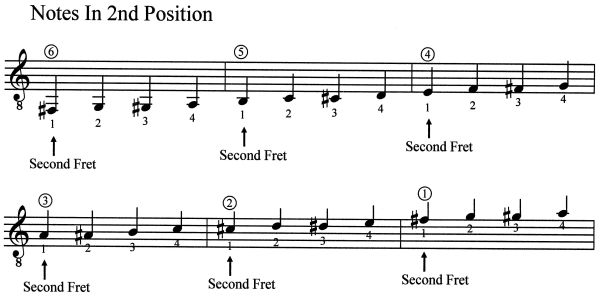


Ex. #8
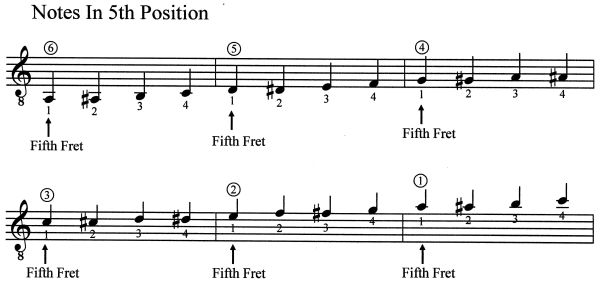


Sight-reading is best done in positions, which minimizes shifting and having to look at the left
hand. We want to keep our eyes on the music as much as possible.

You are on DouglasNiedt.com


Recommended Book and Music to Practice Sight-reading.
Also, What Books NOT To Use

There are many sight-reading books out there. But most of them have a serious flaw. The
exercises in the books are written by the author of the book. The problem is that you have no
idea what the melody you are playing is supposed to sound like. And here you are, trying to
read it in the middle and upper positions of the fretboard, an unfamiliar area compared to the
first or second position. You could be playing it entirely wrong or be making some serious
errors and not realize it, because you are unfamiliar with this unknown (and often unmusical)
tune the writer/composer of the book has written.

Instead, I highly recommend a book titled
Mel Bay's Deluxe Guitar Position Studies by Roger
Filiberto, published by Mel Bay Publications. This book uses many common, well-known
melodies like
Home on the Range, America, Auld Lang Syne, Down in the Valley, etc.
Therefore, if the student is sight-reading
Home on the Range in the unchartered territory of
ninth position, if he messes up, he will realize it. There is some danger that students who play
well by ear will play songs like this without really reading the music. But if they name the notes
out loud as they play, the note-reading aspect will be preserved. The book goes through the
entire fretboard beginning with second position and working up through ninth position. The
pieces selected present a good mix of rhythmic challenges as well. The only minus to the book
is that possibly too much left-hand fingering is given, resulting in some students sight-reading
fingerings instead of notes.

You are on DouglasNiedt.com

Another path to take is to sight-read beginning method books for single-voice instruments
such as violin, clarinet, etc. Beginning violin methods are easily found in music libraries and
some public libraries. They can also be purchased. But remember, we’re sight-reading. Once
you have read through a book once or twice, you won’t use it again. Buying music to sight-
read could get expensive. Pop "fake books" are okay, but the songs can sometimes be too
rhythmically complex for the beginning sight-reader.

When opening up a beginning violin book or the Filiberto book, you will come across an
exercise like this:

Ex. #9


Most intermediate guitarists could certainly read this in first and second position. But could you
read it in fifth position? Or seventh position?


Sight-reading Step By Step

Here is the procedure to follow to sight-read a single-line melody such as Dixie:

You are on DouglasNiedt.com

1. The first thing to do is decide in what position you are going to play the melody. The
advantage with the Filiberto book is that the exercises are presented in a graduated manner
beginning with second-position melodies and progressing from there. Most of the exercises fall
neatly into natural guitar positions, and when they don't, that fact is explained and solutions
suggested. But if you aren't using that book, start with one of the "good" guitar positions--2nd,
3rd, 4th, 5th, 7th, or 9th. You will find that Dixie falls very well in fifth position or seventh
position. The other positions require frequent shifts out of position to play certain notes which
makes sight-reading more difficult.

2. Look at the time signature. The meter of the piece is so important that if one must choose
between perfection of notes and perfection of rhythm, there can be no doubt that the latter
should receive preference. Figure out what beat or count the song begins on. Scan through
the music to find any tricky rhythms and figure out how to count them (how they "go") before
you begin playing. In Dixie, you would possibly want to examine the dotted rhythms and
especially measure eight with the triplet rhythm. Again, count it or tap it out so you know how it
goes.

Ex. #10


Be certain to play what the eyes see. Many students tend to sight-read music they have heard
according to what they assume the sound should be. One must read exactly what is on the
page:

Ex. #11


You are on DouglasNiedt.com

3. Look at the key signature. On the fretboard, find all the sharp or flat notes in the key
signature that fall in the position in which you are playing. In Dixie, Bb is in the key signature.
Therefore, find all the Bb's in the song in the position you have chosen. Here, there is only
one, and it appears in measure one:

Ex. #12


4. Find the lowest note of the piece and the highest note.

Ex. #13


You are on DouglasNiedt.com

5. Find the note range. The range is the lowest note, the highest note, and the notes in
between.
These are the only notes you need to focus on. Play the notes in the range
ascending and descending--it may or may not sound like a scale since the lowest note of the
range might not begin on the tonic or root tone of the key. This will give you the feel for the
notes you will be playing. For
Dixie, in fifth position, you aren't playing any notes on the sixth
string or the Bb and C on the first string, so don't worry about them.

Ex. #14:


The range in seventh position looks like this (on
Dixie, you aren’t playing any notes on the first
or sixth string, so don't worry about them). The notes and the range are exactly the same of
course, as fifth position. Just the fingering is different:

Ex. #15


On the right hand, use whatever comes naturally. You can use fingers only, combination of
thumb and fingers, rest stroke, free stroke, etc. Use whatever is most secure. We are only
concerned here with hitting the right note at the right time!

6. Look for miscellaneous items that might trip you up: accidentals, ornaments, repeat signs,
etc.

7. Look for and play any wide jumps in the melody. Most people do well with scalar melodies
but get lost at wide jumps (a fifth or more) in the melody:

Ex. #16


Ex. #17


8. Set the tempo (a metronome is a good idea) to a speed you can handle comfortably without
being on the edge of your seat. You must always be looking ahead. It is much better to play at
a very slow tempo and maintain the thread than to set too fast a tempo and have to stop and
start in a confused manner.


The Goal

Your goal is to read both the notes and rhythms accurately without a break in the rhythmic
flow. Don't go back to correct a wrong note or other mistake until you have gotten through the
entire piece. The thread must not be broken even if it becomes snarled here and there. The
forward motion of thought, ears, eyes, and fingers must continue uninterrupted.

Keep in mind that sight-reading is not supposed or expected to offer a finished performance.
Even in the advanced stages of reading, don't expect a perfect, finished performance. The
objective of the sight-reader should be to give a general but accurate idea of the piece that is
being read. While attention to musical details is desirable, such details shouldn't be paid for by
the sacrifice of general outline. A goal of 90-95% accuracy in notes and rhythms is good.
We're not expecting a concert-ready performance!

You are on DouglasNiedt.com


The "Eyes" Have It!

Reading notes rapidly presents many of the same problems as reading words rapidly. Part of
the reason "why Johnny can't read" is his inability or lack of training to perceive combinations
of letters as syllables, combinations of syllables as words, and combinations of words as whole
phrases. Does he read c-o-m-b-i-n-a-t-i-o-n-s, or com-bi-na-tions, or combinations? Similarly,
one can be hindered in music reading by an inability to perceive combinations of notes as
melodic lines or chords, and combinations of chords as familiar progressions.

The sight-reader must take in as much of the notation as possible at a glance and must look
ahead deliberately in the score. He can appreciate the problem of deliberately looking ahead if
he has someone else cover each measure while it is being played. The sight-reader must
never think about what he is doing! He must always think about what he is going to do. To look
ahead, the sight-reader will be doing two things at once: 1. recording mentally what is coming
and 2. playing from memory what was previously mentally recorded. Did you get that?
One
does not play the notes at the same moment that the eyes see them!

In a large sense, proficient sight-reading is playing from memory. While the fingers play what
has already been seen, the eyes are looking at what must be played next. At slow tempi the
eyes need be only a little in advance of the fingers. Faster speeds naturally require that the
eyes be looking farther ahead of the fingers. The eyes must maintain enough of a lead to
insure that the fingers will be directed to the correct notes in the correct rhythms without haste
or anxiety. Reading in this manner also means one cannot afford to look at the fretboard. The
reader loses not only time but also his place in the score when he has to keep looking at the
fretboard to locate the notes.

I mentioned having someone cover each measure as it is being played to force the reader to
look ahead. Another way to encourage the reader to look ahead in the music is to set a
metronome to the proper tempo and stick with it no matter what. This may induce a degree of
"faking." But a little faking, if it is the intelligent kind that depends on perceiving harmonic
outlines and omitting only unessential tones, is an important part of sight-reading.


Sight-reading In Positions

So let's return to our example of Dixie. Follow the steps above and try sight-reading it in fifth
and then seventh position (I have provided minimal fingering to make you read the notes, not
the fingerings):

Ex. #18


Ex. #19


The general plan of attack is to continue working on sight-reading melodies of gradually
increasing difficulty. Again, the Filiberto book does that very well. If you are working with pieces
from other books, read them in random positions. Name a number between two and nine
inclusive. Six. Play the piece in sixth position. Name another number. Two. Play it in second
position. Try a few more positions and then go on to another piece and play it in random
positions. Many times, as with Dixie in fifth and seventh position, the entire piece will fall
perfectly into position. No shifts or stretches out of position will be necessary. But just as often,
one may have to reach out of position for a few notes:

Ex. #20


Sometimes one must reach or shift for several notes:

Ex. #21


Notice, as in the example of
America in fifth position, that notes that fall outside of the position
in which you are playing can often be played in two or more locations. It is up to you to decide
which location you prefer.

Although playing
When Irish Eyes Are Smiling in eighth position will be beneficial to one's feel
and knowledge of the fretboard, it would be much easier to sight-read in seventh position,
where all the notes fall perfectly into place:

Ex. #22


Therefore, if a particular position is obviously unsuitable for sight-reading a particular piece,
simply try another position close by. Usually, a change of position one fret up or down will solve
the problem.

Also, in order to maintain the feel of and stay within the bounds of the position we have
chosen, we use the same finger for the same fret every time, even if it results in a little
choppiness. In measures five, six, and seven of Dixie in seventh position, the left-hand fourth
finger jumps from string to string. This produces a less legato sound, but maintains a solid feel
for seventh position for the hand and fingers (the fourth finger could smooth things out a bit by
barring some of the notes instead of lifting from string to string):

Ex. #23


You are on DouglasNiedt.com

Practice Sight-reading Every Day

Remember, practice sight-reading every single day for maximum effectiveness. You can't
master sight-reading by suddenly cramming your study into several six- hour marathon
sessions. Many music majors in university music programs have learned this the hard way
when, trying to pass the sight-reading portion of their piano proficiency exams, failed miserably
because they waited until the last minute to practice their sight-reading.

Don't attempt to read anything more difficult than a single-line melody until you have mastered
that level. Always choose something you can read reasonably well the first try. This is sight-
reading--you do not practice the piece. Play it one to three times (or two or three times in two
or three different positions) and go on to the next piece. If you run across a rhythmic pattern
that confuses you, or a note whose location you are unsure of, AFTER sight-reading the
piece, go ahead and briefly review those spots to clarify the rhythm or note in your mind. Then,
when you run across it again in other pieces, you will sail right through it.

It’s a great idea to sight-read for your teacher. He can monitor your progress, clarify and
correct any rhythmic problems, and direct your study in an efficient manner.


If you think you're a hot-shot sight-reader already, let me tell you about the great
pianist/composer Franz Liszt.

Beyond any doubt, Franz Liszt was the greatest sight-reader who ever lived and all musicians
of the nineteenth century testified to his miraculous powers. An American composer named
Otis B. Boise visited him at Weimar in 1876 bearing a
full orchestral score. Liszt asked him to
play it, and Boise tells the following story:

You are on DouglasNiedt.com


    "There has never been an occasion in my career when my pianistic caliber seemed to
    me so small, as when I for the moment contemplated exhibiting it for the first time to that
    great master; and I also felt that my innocent composition would suffer in his esteem
    through the shortcomings of my piano playing. He evidently noticed my worry and
    relieved me at once by saying, 'I think after all I should obtain a better idea of details if I
    play it myself.'

    Accordingly, he seated himself, glanced at the instrumental scheme, and began the
    most astoundingly coherent rendering of an orchestral score that I had heard and such
    as I never since heard from another musician.

    Those who have attempted such tasks know that the ten fingers being inadequate to the
    performance of all the details, it is necessary to cull such essentials from the mass of
    voices as well as clear the line of development.

    Liszt did this simultaneously. No features of the workmanship, contrapuntal or
    instrumental, escaped his notice, and he made running comments without interrupting
    his progress."


Now, go get started on
Dixie. After all, the rest of us mere mortals have to start somewhere.

You are on DouglasNiedt.com
BE SURE TO VISIT DOUG'S "SECRET VAULT"

It contains many of Doug's Previous
Guitar Technique Tips of the Month
Have a comment?
Question?
Suggestion for the website?
We would love to hear from you.
We have a Printer Friendlier (PDF) version of this article that's also easier on the eyes.
It's SO much easier to read a printed article than to read it from the computer screen.


These are my very detailed, in-depth articles and high-def videos on
how to play the classical guitar. It's like getting your own private guitar
lesson every month.

Need info on classical guitar right hand technique? Guitar scales? How
to play bar chords? Harmonics? Looking for a classical guitar
practicing routine? Tips on performing onstage? How to tune a guitar?
Looking for easy Christmas guitar arrangements?

Chances are, I have covered it, or will soon.

The tips are by subscription only.
Be a better guitar player or teacher. SUBSCRIBE NOW!

Purchase a ONE-YEAR SUBSCRIPTION to:

DOUGLAS NIEDT'S
GUITAR TECHNIQUE TIP OF THE MONTH

Doug's Guitar Technique Tip of the Month will be sent to you monthly. These are the best on the
Internet. No one else's technique articles and videos even come close. Most of the written tips run
over 20 pages. Most of the videos run from 15-30 minutes. The tips are thorough and the
production is excellent.
Check out the free tips in Doug's Vault for a sampling.

A one-year subscription (12 tips) is only $24. That is only $2 per tip.
Be a better guitar player or teacher. SUBSCRIBE NOW!

Purchase a ONE-YEAR SUBSCRIPTION to:

DOUGLAS NIEDT'S
GUITAR TECHNIQUE TIP OF THE MONTH

Doug's Guitar Technique Tip of the Month will be sent to you monthly. These are the best on the
Internet. No one else's technique articles and videos even come close. Most of the written tips run
over 20 pages. Most of the videos run from 15-30 minutes. The tips are thorough and the
production is excellent.
Check out the free tips in Doug's Vault for a sampling.

A one-year subscription (12 tips) is only $24. That is only $2 per tip.