Guitar Technique Tip of the Month
Your Personal Guitar Lesson

Any ascending arpeggio can be played with or without a technique called planting. Most beginners have little experience with planting and some guitarists use the technique without even realizing it. Here is how it works.

Contact Me
Do you have a question?
Comment?
Suggestion for the website?

PDFs and Video Downloads
We provide this Technique Tip as a PDF you may download to your computer.
Download Right-Hand Planting Technique for Arpeggios
Note: You must have Adobe Reader 10 or later installed on your computer to play the videos contained in the PDFs. Download Adobe Reader here.
RIGHT-HAND PLANTING TECHNIQUE FOR ARPEGGIOS
By Douglas Niedt
Copyright Douglas Niedt. All Rights Reserved. This article may be reprinted, but please be considerate and give credit to Douglas Niedt.
Any ascending arpeggio can be played with or without a technique called planting. Most beginners have little experience with planting and some guitarists use the technique without even realizing it. The following arpeggio can be played with or without planting (ex. #1):
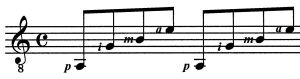
Playing this arpeggio without planting simply means that as the fifth string is played by the thumb, "i" is hovering above the third string ready to play, "m" is hovering above the second string ready to play, and "a" is hovering above the first string ready to play. As "i" plucks the third string, "m" and "a" continue to hover above their strings. As "m" plays the second string, "a" continues to hover above the first string and "i" has returned to its position hovering above the third string. As "a" plucks the first string, "i" continues to hover above the third string and "m" returns to its position hovering above the second string. Finally, as "p" plays the fifth string again, "a" returns to its position hovering above the first string and of course "i" and "m" are still hovering above their respective strings.
The important thing to note here is that only one finger is touching one string at a time allowing the other strings to ring. Never does a finger touch a string (thereby cutting off its sound) while another finger or the thumb is playing another string.
Therefore, when the thumb plucks the fifth string, all the treble strings are still ringing producing the following effect (ex. #2):

In the planting technique as "p" plays the fifth string, "ima" are placed or planted simultaneously on their respective strings: "i"on the third string, "m" on the second string, and "a" on the first string.
The fingers should be planted securely with the string seated against each fingernail on the left side of the nail. In other words make sure the fingers are planted in the exact spot from which they actually pluck the strings. Don't place the fingers so they are on the flesh only or so they are against the string in the center or right side of the nail.
Also be certain to plant the three fingers together. When planting, take hold of the strings securely. Don't just rest the fingers lightly on the strings. Grab hold of the strings and apply pressure on them into the guitar as if you were going to push the strings into the soundhole.
When "p" plays the fifth string, "ima" should be resting on their strings. Then play the third string with "i" from its planted position. Don't let "i" come off the string or loosen its grip on the string momentarily before plucking. The entire idea of planting is to have the fingers prepared to play. If you reposition the finger before plucking the string, you waste the effort it took to plant the finger in the first place.
As the third string is played, think of it as a releasing motion rather than an active plucking motion. Remember, you have planted the finger forcefully and are already pushing it into the soundboard. All you have to do is let go with a slight plucking movement. This means you can use a very small follow-through which will increase the speed of the arpeggio.
You will also get a very good tone. Free stroke tone is dramatically improved when the finger pushes into the string and releases rather than plucking the string outward or upward.
As "i" plays the third string keep "m" and "a" locked onto their strings. Don't let either finger release its pressure on the string or worse, come off the string altogether.
After "i" plucks the 3rd string, it should hover no more than 1/2 inch above the 4th string.
Next, "m" will play the second string as "a" lies prepared on the first string. As with "i", don't reposition "m" on the second string before it plays. If you planted the finger correctly, it is ready to go and will only require that you release the string.
After "m" plucks the 2nd string, it should hover no more than 1/2 inch above the 3rd string.
Finally, "a" will play the first string. After "a" plucks the 1st string, it should hover no more than 1/2 inch above the 2nd string.
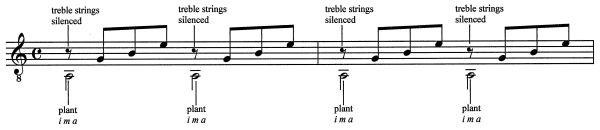
Then, when the thumb plays the next bass note, all three fingers are re-planted on their strings and the entire process is repeated (ex. #3):
Planting is only used in ascending arpeggios or the ascending portion of a longer arpeggio, not in descending arpeggios (ex. #4):

There are four major advantages to using planting, although the fourth can be a disadvantage in many situations.
-
Advantage number one is the sense of security planting gives the right hand. Having all the fingers prepared on their strings means nothing can go wrong-you are assured of playing the correct string. You are also able to hold onto something to steady the hand. If you get nervous, you won't have fingers hovering above the strings shaking or feeling weak and out of control. And remember, when the right hand is secure, a feeling of greater security is also imparted to the left hand nearly doubling the benefits of the planting technique.
- Advantage number two is a good command of tone. Because the fingers are planted on the strings on the left side of the fingernail with the string seated firmly against the nail and flesh with downward force on the string, you are assured of getting an excellent sound. Planting makes you more aware of the position of the fingernail and flesh against the string and so heightens your sensitivity of touch.
- Advantage number three is speed. Most arpeggios can be played much faster with planting than without. The preparation of the fingers combined with the feeling of security makes fast playing much easier. However, it should also be noted that some players feel they can control the evenness of arpeggios better without planting. But again, the top speed at which a given arpeggio can be played without planting can be bettered dramatically when planting is employed.
-
Advantage number four is that planting gives clear separation between arpeggio groups. As indicated in example number three above, as the thumb plays its bass note, the treble strings are silenced. Because the planting of "ima" cuts off the sound of the ringing treble strings, each arpeggio group is clearly separated from its neighbors.
This is often desirable when a clean separation between harmonies is desired-somewhat analogous to the way a pianist lifts the sustain pedal to prevent chords from ringing together. Notes and chords that ring together (especially in the low register) can obscure the sound or cause dissonances or clashes which are inappropriate for particular passages or styles of music.
However, in other music (romantic and impressionistic music immediately comes to mind), it may be entirely appropriate and desirable to "hold the sustain pedal down"-- i.e. not use planting and allow as many notes from one chord to ring into the next chord as possible.
The best thing to do is to master the technique of planting, and then use it or not according to what sounds best in a particular piece or passage.
PDFs and Video Downloads
We provide this Technique Tip as a PDF you may download to your computer.
Download Right-Hand Planting Technique for Arpeggios
Note: You must have Adobe Reader 10 or later installed on your computer to play the videos contained in the PDFs. Download Adobe Reader here.