Guitar Technique Tip of the Month
Your Personal Guitar Lesson


Contact Me
Do you have a question?
Comment?
Suggestion for the website?

PDFs and Video Downloads
You may download a PDF version of this technique tip.
Download ONE OF THE TOP TEN FOUL AND NASTY HABITS:
Allowing the Helpless Pinky To Be Pushed Around
Note: You must have Adobe Reader 10 or later installed on your computer to play the videos contained in the PDFs. Download Adobe Reader here.
ONE OF THE TOP TEN FOUL AND NASTY HABITS:
Allowing the Helpless Pinky To Be Pushed Around
By Douglas Niedt
Copyright Douglas Niedt. All Rights Reserved. This article may be reprinted, but please be considerate and give credit to Douglas Niedt.

THE TOP TEN NASTY HABITS of Guitar Technique
This article is the first in a series published from time to time, of common technical bad habits that can wreak havoc with your playing. They are presented in no particular order of importance.
This habit is so disgusting and troubling; I hesitate to even discuss it in a family setting where young crumb crunchers might be present. This one is absolutely one of the Top Ten Nasty Habits of Guitar Technique.
In this first video clip, here I am, minding my own business playing Andante op. 241, no. 5 by Ferdinando Carulli, when all of a sudden, as the 3rd finger reaches across the neck to play the C on the 5th string, the innocent and unsuspecting pinky (the left-hand 4th finger--also known as the "little finger") gets pulled along with it. Kidnapped! Abducted by force! Oh, the horror!
Watch this shocking video clip:
What should happen is that the pinky should be independent of the 3rd finger and stay on the treble-string side of the fretboard. Specifically, the pinky is going to play D on the 2nd string at the 3rd fret and therefore should hover above the 2nd string about 1/4 inch away:
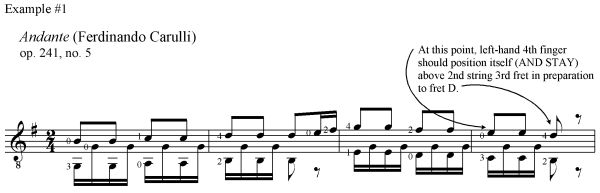
Unfortunately, if you are one of the many who are afflicted with this nasty habit, the third finger pulls the pinky with it over to the bass-string side of the fretboard. Our innocent pinky must then scramble and lunge to return to the other side of the fretboard to get to the 2nd string in time to play the D.
Watch me as I demonstrate for our studio audience how to position the 4th finger correctly in this award-winning video clip.
Now, let's look at this example from Moderato op. 35, no.2 by Fernando Sor:
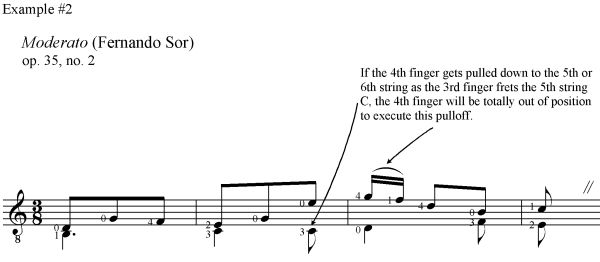
When playing measure 2 to measure 3 in the example, there is a disaster waiting to happen. On beat 3 of measure 2, the 3rd finger frets the 5th string C. If the 4th finger gets pulled to the 5th or 6th string, it will be totally out of position to execute the pulloff on the first beat of measure 3. To compensate for the pinky being out of position, the 3rd finger will lift off the low C early, clipping it short. The 4th finger will make a mad dash for the high G. Many beginners do not have good control and speed of movement with their little fingers. To "help," the left-hand wrist will probably turn outward, further disorienting the hapless pinky as to where the first string is. Chaos. It ain't pretty.
Watch what I've just described with your own eyes. Ladies and gentlemen, this one is shocking. No one will think less of you if you have to turn your eyes away from this scene of horror.
Why It Matters
This nasty habit is seen frequently in beginning to intermediate players and is responsible for many of the problems the left-hand 4th finger has with control, security, and accuracy. Quite simply, the 4th finger gets pulled out of position by the 3rd finger. Instead of preparing itself about 1/4 inch above the string to drop effortlessly and accurately to its destination note, the pinky gets pulled away (sometimes even upward) and must then scramble to fight its way back to the other side of the fretboard in time to land at its destination. Sometimes, a player is conscientious and prepares the 4th finger properly and precisely. But at the last moment, it still gets pulled violently out of position when the 3rd finger reaches towards a bass string to fret its note.
The experience for the little finger is similar to you positioning yourself to effortlessly sit down in a chair. You stand by the chair and begin to lower yourself when suddenly; someone grabs you by the arms and pulls you to the other side of the room. Then you sprint back to the chair and while still running at full speed, attempt to sit down. Yes, you will probably make it, but sometimes you will fumble for the chair or even stumble. If you do make it, you will be out of breath and somewhat frazzled by the effort. Now, imagine having to do this over and over. That is what many players' 4th fingers do in daily guitar playing!
All this extra movement also results in overworking the little finger, leading to stress and physical strain. For most beginning to intermediate students, the little finger is the weakest finger on the left hand. In order to "help out" the finger, to compensate for its weakness, the left hand will twist or turn outward away from the neck, causing problems for the other fingers and condemning the little finger to perpetual subjugation.
How to Fix It
These exercises will develop the specific muscles needed to keep the little finger on the treble-string side of the fretboard as the 3rd finger reaches across to the bass-string side.
Watch as I demonstrate all the following exercises for our studio audience. It's absolutely riveting, folks. Actually, it's kind of like watching paint dry. But watch it anyway.
Try this first:
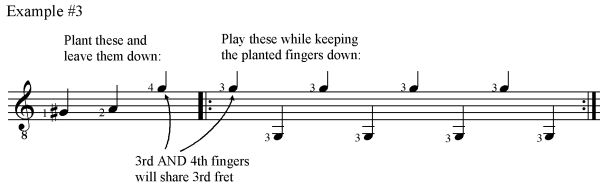
This one is a little more difficult:
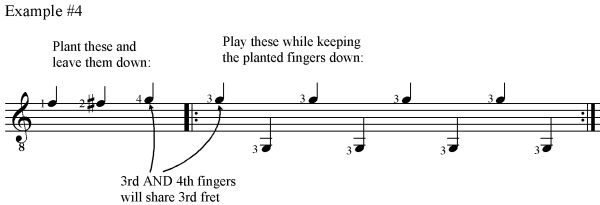
Both exercises may be too difficult for some players. If that's the case, work up to them with the following exercises, which accomplish the same end, but are easier to execute:
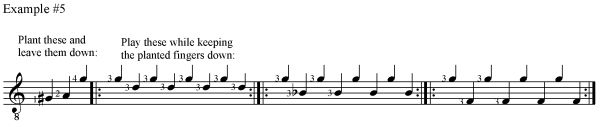
And finally:
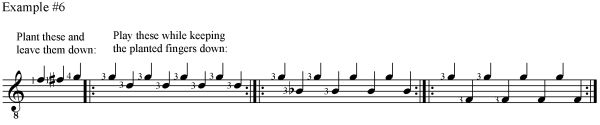
Once you can play these exercises as outlined above, try them without planting the 4th finger. Watch your pinky. Don't let it follow the 3rd finger. Then try the exercises while keeping the pinky on the 1st string G but without planting the 1st and 2nd fingers. Finally, try them without planting any fingers. Just move the third finger from the 1st string G to the 6th string G without letting the pinky follow.
Each day after practicing these exercises, return to the Carulli and Sor examples here. If you focus on the little finger (in other words don't take your eyes off of the little finger) and move slowly, you will be able to play the passages (and others like them) and keep the 4th finger over the treble-string side of the fretboard as the 3rd finger reaches across to the bass strings. It is a very significant accomplishment to achieve that much finger independence between the 3rd and 4th fingers.
Help your pinky reform. Teach it self-esteem and independence. Help it become a useful member of society instead of being helplessly dragged off to the wrong parts of town (such as the bass-string side of the fretboard). Teach it to not allow bad influences like the 3rd finger to push it around. Give it some backbone for gosh sake.
PDFs and Video Downloads
You may download a PDF version of this technique tip.
Download ONE OF THE TOP TEN FOUL AND NASTY HABITS:
Allowing the Helpless Pinky To Be Pushed Around
Note: You must have Adobe Reader 10 or later installed on your computer to play the videos contained in the PDFs. Download Adobe Reader here.