Guitar Technique Tip of the Month
Your Personal Guitar Lesson


Contact Me
Do you have a question?
Comment?
Suggestion for the website?

PDFs and Video Downloads
You may download a PDF version of this technique tip.
Download Pre-Planting at the Beginning of a Piece
Note: You must have Adobe Reader 10 or later installed on your computer to play the videos contained in the PDFs. Download Adobe Reader here.
Classical Guitar Technique:
PRE-PLANTING AT THE BEGINNING OF A PIECE
By Douglas Niedt
Copyright Douglas Niedt. All Rights Reserved. This article may be reprinted, but please be considerate and give credit to Douglas Niedt.
Here is a tech tip that is very simple and obvious. But it's one that I don't see mentioned much, and one we sometimes forget about because it is so obvious. That tip is very simple:
Always pre-plant all the fingers of BOTH hands that are needed to play the very first note, interval, or chord of a piece.
"Pre-plant" means to firmly place or set the fingers of BOTH hands on the strings before you pluck them. The wonderful benefit of this procedure is security. If the fingers of both hands are on their strings for that first note, interval, or chord, not much can go wrong! You're off to a solid start. Plus, any shakiness or trembling of hands due to nervousness is reduced, at least for a moment.
When you pre-plant the right-hand fingers, be certain the fingernails are on the strings. If a finger is planted on just the flesh, you will probably get a click or even get caught on the string when the string slides from the flesh and then hits the nail. Be sure you are on the flesh and nails simultaneously (usually the left side of each fingernail) before beginning to play. Be sure to check every finger including the thumb! Sometimes one or two fingers will be set on the strings correctly, but another (often the "a" finger) will not have its nail on the string.
On the left hand, be certain to position each finger very precisely as needed for the particular opening note, interval, or chord you are playing. Sometimes a finger needs to be right up against the fret. Other times it needs to be in the middle of the fret. Sometimes it must be placed on its very tip. Other times it may need to be placed further back from the tip. Press firmly and confidently so that the first sound you produce is solid and clear.
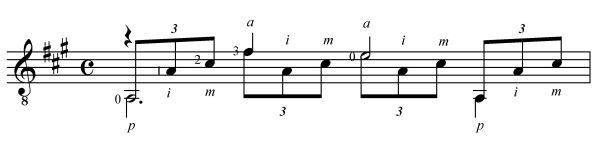
Let's look at the first measure of Matteo Carcassi's Etude, Op. 60, No. 3:
Example #1
<>br>
On the left hand, we would pre-plant the first, second, and third fingers on the first three strings. On the right hand, we would plant "p" on the fifth string, "i " on the third string, "m" on the second string, and "a" on the first string.
Ex. #2
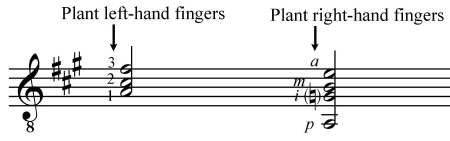
In the Danza, the third piece in Oscar Chilesotti's Six Lute Pieces of the Renaissance, we would pre-plant the first finger of the left hand on the fourth string, the second finger on the fifth string, and the third finger on the first string. On the right hand, we would set the thumb on the fifth string, "i" on the fourth string, "m" on the second string, and "a" on the first string:
Ex. #3

At the beginning of Carcassi's Etude, Op. 60, No. 7, we would pre-plant the thumb on the fifth string with its nail and flesh firmly seated against the string. The left-hand second finger would be planted on the third string at the second fret:
Ex. #4

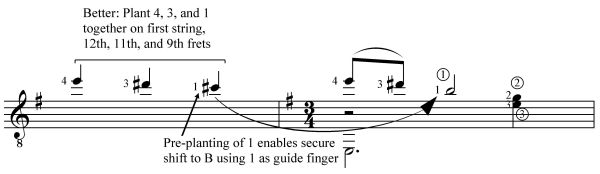
Sometimes it's advantageous to pre-plant additional fingers for reasons of stability and added confidence. Let's look at the opening of Adelita by Francisco Tárrega:
Ex. #5
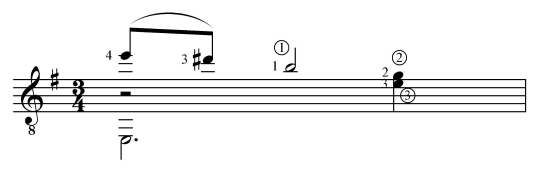
It would definitely be a good idea to pre-plant both the left-hand third and fourth fingers on the first string at the eleventh and twelfth frets for stable execution of the opening slur:
Ex. #6
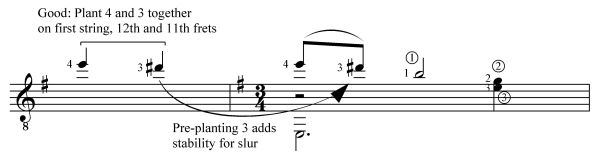
But I think it's even better to also pre-plant the first finger on the first string at the ninth fret to add even more stability to the execution of the slur. PLUS, instead of having to "jump" to the first-string B at the seventh fret on the second beat, you will now have the first finger already set securely on the string to act as a guide finger to enable a very stable shift down to the seventh fret B:
Ex. #7
But the fingers are only half (or less) of the picture. The other component to beginning a piece is the brain! When you watch professional athletes and performing artists (I find many interesting parallels between the two), you will often observe them "getting into the moment" before their activity. The weightlifter, ballet dancer, golfer, singer, ice skater, pianist, etc. all take that moment (sometimes it's quite a long moment) to focus their minds on the physical movement they are about to make. We guitarists must also engage the brain before playing the first note, interval, or chord of a piece.
In your head, hear and feel the opening notes. Lock into a tempo, hear the sound, and feel the mood. You can do this with your eyes open or closed. You can do this before or after you pre-plant the fingers.
It is very important to establish the tempo in your head and body (tap your toes in your shoes) before you begin so you don't come racing out of the starting gate too fast, out of control. In a public performance, adrenaline will be coursing through your veins and will cause you to play faster than you're accustomed to, causing all kinds of problems as you proceed. If the piece is fast, it's a good idea to hear the most difficult part of the piece in your head and set your tempo to that. But even in slow pieces, it's important to carefully set the tempo in your head. With the adrenaline flowing, you can ruin the beauty of a slow piece by playing it too fast, even if you play it technically flawlessly.
Then there's the mood. In a performance, you want to grab, hook, capture and enrapture your listeners immediately from that first note. It shouldn't take several measures to "get into it." Before playing that first note, feel the mood of the piece—happy, sad, ecstatic, grieving, joyous. Or, perhaps the piece brings a picture, scene, or story to your mind. Focus clearly on that picture, scene, or story before you begin.
And again, all the "brain prep" can be done before or after the pre-planting of the fingers. Try it both ways and see which works best for you.
Brain prep and finger pre-planting—use both and you'll have a boffo beginning.
For those unfamiliar with the word "boffo":
Boffo (BAHF-oh)
Adjective
1. (Of a movie, play, or some other show) Extremely successful.
2. (Of a laugh) uproarious, hearty.
Noun
1. A great success.
2. A hearty laugh.
3. A gag or punch-line that elicits uproarious laughter.
Of uncertain origin. Probably a blend of box office or an alteration of buffo, bouffe, or boffola.
The term was popularized by Variety, a magazine for the U.S. entertainment industry.
PDFs and Video Downloads
You may download a PDF version of this technique tip.
Download Pre-Planting at the Beginning of a Piece
Note: You must have Adobe Reader 10 or later installed on your computer to play the videos contained in the PDFs. Download Adobe Reader here.