Guitar Technique Tip of the Month
Your Personal Guitar Lesson


Contact Me
Do you have a question?
Comment?
Suggestion for the website?

PDFs and Video Downloads
You may download a PDF version of this technique tip.
Download No Girly-Men Guitarists Here
Note: You must have Adobe Reader 10 or later installed on your computer to play the videos contained in the PDFs. Download Adobe Reader here.
INCREASE YOUR LEFT-HAND STRENGTH
By Douglas Niedt
Copyright Douglas Niedt. All Rights Reserved. This article may be reprinted, but please be considerate and give credit to Douglas Niedt.
You simply can't have enough left-hand strength. You need to be able to hold those big stretchy chords and bar chords without getting buzzes and muffled notes and without getting fatigued. Your left hand needs to be able to get through a lesson or an entire performance of heavy duty repertoire without getting tired. When the left hand gets tired, not only do strings start to buzz and notes get muffled, but you begin to lose your fine motor movement control and begin to make mistakes even on simpler single-note passages. Fatigue in the left hand can even lead to tenseness and therefore loss of control in the right hand.
Macho-Monster Guitar Chords
Want to know a great way to tremendously increase your left-hand strength in just two weeks without appreciably increasing your overall practice time?
It's very simple. Practice your arpeggio exercises (which you should be doing anyway) while holding bar chords. Not just any bar chords, but the macho-monster bar chords I have written out for you below--all of which you will eventually encounter in some form in actual repertoire you play.
CAUTION! CAUTION! CAUTION! If you currently have hand problems--tendonitis, recurring pain, whatever--I would NOT practice these, but if you want to try them, be very careful that they don't exacerbate your problem. Some would say there is a possibility that by strengthening the hand, your pain problems might actually subside. But stop playing these immediately if your pain increases. There is nothing macho or positive about playing with hand pain.
If your hands are healthy, and you conscientiously practice your arpeggios every day using these bar chords, you will definitely notice an increase in your hand strength in just two weeks. You will notice not only that you can hold difficult chords more easily and that they buzz less (if at all), but you will notice an increased fluency in your overall playing simply because your hand has more reserve strength at its disposal and doesn't get fatigued.
How to practice Macho-Monster bar chords
It doesn't matter if you practice the traditional Giuliani arpeggios, the Carlevaro arpeggios, El Abejorro by Emilio Pujol, Etude No. 1 by Villa-Lobos or any other arpeggio studies or formulas--instead of practicing the right-hand patterns with the chords they specify, hold these macho-monster bar chords instead.
If you have problems playing ANY bar chord, first refer to my article,The Secret (Little Jennifer's Secret) of How to Play Clear Bar Chords. In order to play these macho-monster bar chords, you will definitely need to use both your arm strength as emphasized in that article, AND your left-hand thumb strength. Don't rely on either one alone: use both.
One very important fact to know is that bar chords are hardest to hold when the bar is at the first fret. They are much easier to hold when the bar is at the third, fourth, or fifth fret. So if they aren't coming out well at the first fret, try them higher up the neck first, and over time work your way down to the first fret.
Don't be concerned if at first you can't even get half the notes to come out clearly. Just do the best you can and as your hand strengthens, more strings will come out clearly. You can still hear the evenness of your arpeggios and work on your right-hand technique even when the strings are muffled or buzzing.
You will want to adapt whatever arpeggio pattern you are practicing so that you eventually play all the strings in the bar chord. Have the thumb pluck alternate bass strings so it isn't always playing the same bass string. Or if the pattern only has "i" and "m" playing two strings, have them play not only the first two strings, but also have them play the same pattern on the second and third strings. That way you are learning to hold all the strings down tightly, plus it gives more variation to your arpeggio patterns.
IMPORTANT: You may only be able to hold some of these chords for five to thirty seconds before you cry "uncle." That's o.k. Hold a chord for a while, then practice on open strings to rest your hand. Then go back to a bar chord. Practice on the chords that are easier for you at first. Gradually increase the amount of time you hold the bar chords.
TENSENESS AND FATIGUE in the left hand are o.k. PAIN IS NOT O.K. If this hurts, don't do it.
As you increase the amount of time you are able to hold these chords, also work your way down to the first fret, as mentioned above. Push yourself and try for clarity but realize that a few buzzes and muffled notes are inevitable at first.
Use your common sense. Push yourself but don't overdo it and hurt yourself�use the open strings frequently to rest the hand.
You can also practice harmonic progressions with these chords (these forms are all movable bar chords). I like to practice--I, IV, V (or V7), I. Play the circle of fifths in the dreaded flat keys:
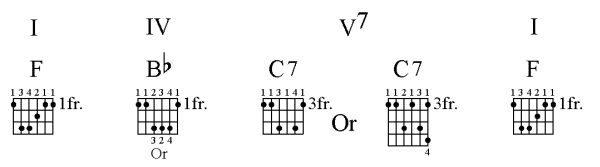
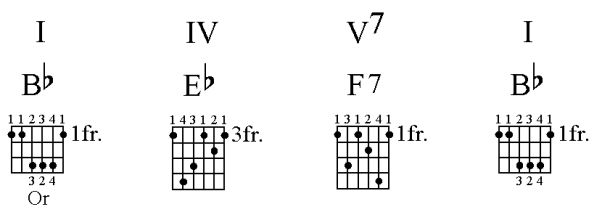
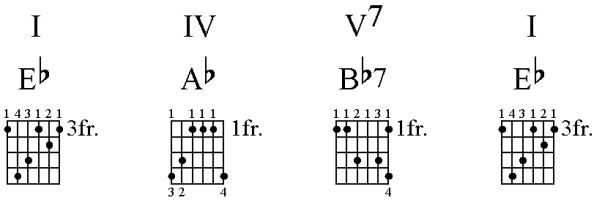
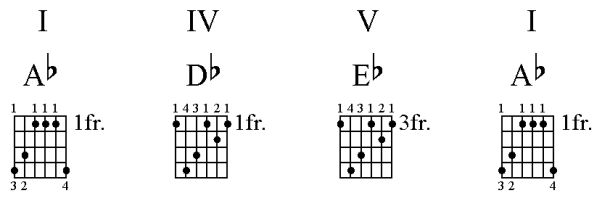
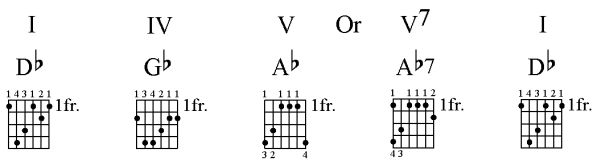
Depending on the arpeggio pattern, I will play the pattern two to four times or more on each chord. However, these chord changes can be very difficult--if you are practicing arpeggios, you are supposed to be focusing on your RIGHT hand, not the left-hand changes. So if you find yourself focusing more on the left-hand changes than your right-hand arpeggio work, you might want to just hold one chord for awhile, stop, then grab another chord, stop, grab another chord, etc. so your focus stays on the right hand.
Improve the independence of your hands
One final benefit of practicing arpeggios with macho-monster bar chords is that it will improve the independence of your hands. Usually, intense pressure applied by one hand (as is the case here with the left hand), transfers to the other hand. That is very undesirable. Stay focused on the right hand, keeping it loose and relaxed. The contrast between that looseness and the extreme tension in the left hand will impress itself very strongly on your neuromuscular system, heightening your awareness of any tension transfer from the left to the right hand.
While other guitarists are trembling on their footstools trying to hold an Ab major bar chord at the first fret for four largo measures, you will be smiling, eagerly awaiting the eight measures of Db major (with a ritard) that come next!
PDFs and Video Downloads
You may download a PDF version of this technique tip.
Download No Girly-Men Guitarists Here
Note: You must have Adobe Reader 10 or later installed on your computer to play the videos contained in the PDFs. Download Adobe Reader here.