Guitar Technique Tip of the Month
Your Personal Guitar Lesson


Contact Me
Do you have a question?
Comment?
Suggestion for the website?

PDFs and Video Downloads
You may download a PDF version of this technique tip.
Download Classical Guitar Shifts—Look Before You Leap
Note: You must have Adobe Reader 10 or later installed on your computer to play the videos contained in the PDFs. Download Adobe Reader here.
SHIFTS ON THE CLASSICAL GUITAR
"Hey Bud, Look Where You're Going" or,
Look Before You Leap
By Douglas Niedt
Copyright Douglas Niedt. All Rights Reserved. This article may be reprinted, but please be considerate and give credit to Douglas Niedt.
Here is a technique tip that is very simple but has the potential to improve your playing a lot. It is one of those things you think, "Wait, that's too simple. There has to be more to it than that." And yes, there are a couple conditions that must be met for the tip to work but it is still fairly basic.
Which Finger is the Culprit?
We are constantly faced with difficult chord changes and shifts. When you shift or jump to a chord and you mess it up, it is usually the fault of one finger on the left hand. Most of the time, the 4th finger is the one that misses. The second most frequent culprit is the 3rd finger.
Find a change with which you have difficulty. Play it several times and keep score of which finger misses its destination the most. Pay close attention; it is almost always one finger that causes the shift to fail.
You have to choose the correct finger on which to focus. For example, many times a player will look at the destination fret where a bar lands. Usually, the bar doesn't cause one to miss a change. Most of the time it is one of the other fingers that misses its landing point. That is the finger whose destination point needs to be focused on, not the bar. So be sure you focus on the right finger.
Focus on the Landing Point
To ensure that the wayward finger lands accurately (thus producing a perfect chord change), all you have to do is focus your eyes on its landing spot on the string.
Important:
When I say "landing spot," I am not talking about looking at the destination fret in general. I am talking about looking at a point on the string—a point about the size of the period at the end of this sentence. You must focus your eyes on the spot with laser-like precision.
You will rarely miss the shift as long as two conditions are met:
Condition #1:
You must focus on the landing point before you shift. You can't wait to look where you are supposed to land at the last split second. You must have a few milliseconds of lead time.
Condition #2:
The finger must be reasonably prepared or positioned to make the shift. For example, if you must land the finger on the 6th string, the finger must be hovering above the bass strings, not the trebles. The finger must be no more than an inch above the string—the closer the better. The tip joint must be bent so the tip of the finger is pointing down at the strings, not pointing across the fretboard or even worse, upwards.
The Human Body Is an Amazing Thing
This technique tip uses a basic ability we all have: hand-eye coordination. The human body is an amazing thing. If you focus intensely at your landing point and have the finger reasonably prepared, you simply won't miss. Your neural-muscular system will make it happen. Of course, since we are human, we can do all kinds of mental things to screw everything up. We can get tense, our minds can wander, and we can let self-doubt confuse the muscles. But if we allow our neural-muscular system to work as it was designed, and keep our negative thoughts out of it, it will work flawlessly.
Some Examples of the Technique in Action
Here is an example of a chord change from Erik Satie's Gymnopedie No. 1:
Ex. #1
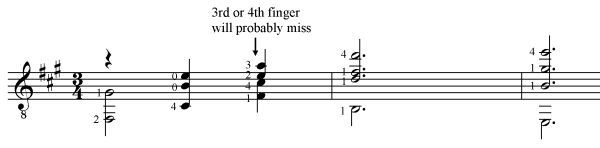
Watch video clip #1 demonstrating the technique.
Here is an example from Prelude No. 1 by Heitor Villa-Lobos:
Ex. #2
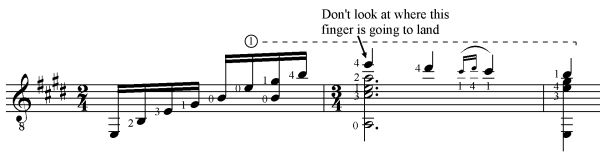
Watch as I demonstrate the passage in this stunning clip (video clip #2).
Here is an excellent example from the well-known piece Romanza or Romance de Amor.
Ex. #3

Video clip #3 will keep you glued to the edge of your seat. This video shows how the element of finger preparation is crucial to making this technique work.
Finally, here is a problematic change in the Etude No. 1 by Heitor Villa-Lobos:
Ex. #4

Watch video clip #4.
Once again, for this technique to work you must:
- Determine which finger fails to land accurately when executing the chord change. Usually it is the 4th finger. The next most common culprit is the 3rd finger.
- Focus intently on the finger's landing point on the string. It is a point on the string, not a fret.
- Look at the point at least several milliseconds before you shift.
- Be sure the finger is prepared reasonably close to the string or fret it is supposed to land on.
I think you will be amazed at how accurate and consistent your chord changes and shifts become.
PDFs and Video Downloads
You may download a PDF version of this technique tip.
Download Classical Guitar Shifts: Look Before You Leap
Note: You must have Adobe Reader 10 or later installed on your computer to play the videos contained in the PDFs. Download Adobe Reader here.