Guitar Technique Tip of the Month
Your Personal Guitar Lesson


Contact Me
Do you have a question?
Comment?
Suggestion for the website?

PDFs and Video Downloads
You may download a PDF version of this technique tip.
Download Interval and Chord Balance, Part 2 of 4
Note: You must have Adobe Reader 10 or later installed on your computer to play the videos contained in the PDFs. Download Adobe Reader here.
Classical Guitar Technique:
INTERVAL AND CHORD BALANCE, PART 2 of 4
By Douglas Niedt
Copyright Douglas Niedt. All Rights Reserved. This article may be reprinted, but please be considerate and give credit to Douglas Niedt.
In last month's technique tip, I discussed exercises and techniques to learn to control the volume of each note of an interval independently. Therefore, if you are studying say, Galileo's Saltarello (from Chilesotti's Six Lute Pieces of the Renaissance), you should now be able to control the balance between the upper melodic part and the ostinato bass:
Example No.1:
Measures 1-4. Saltarello by V. Galileo

If your teacher tells you, or you yourself notice that the bass notes are overriding the upper part, you should be able to adjust your touch to produce whatever balance you desire. Or, on Prelude No.2 by Manuel Ponce (from Preludes 1-6):
Example No. 2:
Measures 1-4. Prelude No. 2 by Manuel Ponce

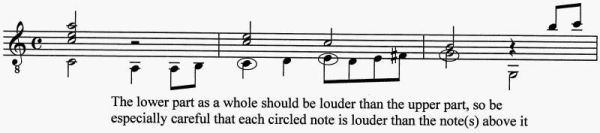
You should be able (no matter what right hand fingering you use) to bring out the short counter-melodies in measures two and three (and similarly measures six and seven). In the Pavanas in A Minor by Gaspar Sanz you should now be able to play the notes E and G in the bass line quite a bit louder than the C and B above them and match the volume of the E and G with the volume of the other single bass notes around them:
Example No. 3:
Measures 20-22. Pavanas by Gaspar Sanz.
Balancing three and four-note chords
Whether playing a three-note chord with pim, pma, pia, or ima or a four-note chord with pima, the technique for learning to bring out one particular finger louder than the others is the same. We will use the following chord as an example:
Example No. 4:
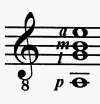
To work on bringing out the note G (which is played by i) louder than the other notes, use the procedure we discussed last month (Part 1). Rest p, m, and a very lightly on their respective strings--so lightly that they are barely touching the strings. Keeping in mind that volume is primarily the result of how far a string is pulled before it is released, pull the third string hard with i until the third string is almost touching the fourth string. But be careful that when you pull with i that you do not pull or increase the pressure of p, m, or a on the strings. Take note of how the fingers feel--p, m, and a feeling very loose and relaxed while i feels the pressure of the third string biting into it as it pulls on the string.
Then release the third string while lightly brushing the first, second, and fifth strings with a, m, and p. Practice this exercise over and over, feeling the independence of the movements of i from those of p, m, and a. Once the fingers get the feel of the correct physical balance, try to capture that feeling without pre-planting the fingers on the strings but still retaining the feeling that i is pulling hard on the third string while p, m, and a lightly brush the other strings. Apply this practice technique to m, a, and finally the thumb until you can bring out any note of a three or four-note chord forte while playing the other notes pianissimo. Let us look at some examples in which this technique is used. In Prelude No.6 by Manuel Ponce we come upon the following passage:
Example No. 5:
Measures 21-25. Prelude No. 6 by Manuel Ponce.

The melodic line which must be brought out very clearly and evenly is found in the middle voice. It is essential that the melodic tones occurring within the chords be played with the same volume and tone quality as the melodic notes sounding singly. To maintain this even volume and tone quality, I would recommend that either i or m be used on every melodic note. I personally would use m because I find that when playing a three-note chord, it is far easier to bring out m when playing pma than to bring out i when playing pim or pia. I would not use a finger to play the melodic notes within the chords and the thumb to play single melodic notes--the difference in tone quality between the finger and thumb would give the melody an uneven sound.
A common occurrence in Renaissance and Baroque music is the suspended note found in an inner voice of a chord:
Example No. 6:
Measures 6-8. Bianco Fiore by Cesare Negri.
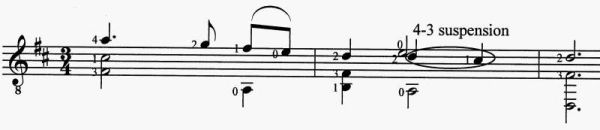
The D to the C sharp is a 4-3 suspension which is a very common type in early music. Keep in mind that suspensions almost always serve as focal or climatic points of phrases. Not only is the D to be played louder than the E above and A below, but it should be accented as well.
A striking example of the importance of chordal balance occurs in the Pavanas in A minor by Gaspar Sanz:
Example No. 7:
Measures 1-4. Pavanas by Gaspar Sanz.

The trill occurs in the tenor voice and is played with i. The fact that the trilled notes comprise a 4-3 suspension above the root of the chord (the note E) indicates the trill's harmonic importance which is underscored by the repetition of a 4-3 suspension at the end of a phrase. Therefore, it is imperative that the note A, which begins the trill, be clearly played as the dominating tone the moment the chord is struck. (It should be pointed out that another technique using the thumb to play the initial note A of the trill could be used to balance the chord correctly. (This technique will be discussed in Part 3.)
Examples such as these and countless others can be found where inner notes and voices of three and four-note textures must be clearly brought out. But even more common is the situation where the pristine melody sings in the upper voice:
Example No. 8:
Chorus. Jesu, Joy of Man's Desiring by J.S. Bach.

But the player must decide exactly what the balance is to be. Will the soprano be heard almost to the exclusion of the other parts? Or just slightly louder? The important thing to remember is that with the ability to alter the balance of a chord at will, you can now make a choice and execute it. You have a new technique you can use to add variety, intelligence, and vitality to your playing.
Next month (Part 3) I will discuss some special balancing techniques involving the thumb.
PDFs and Video Downloads
You may download a PDF version of this technique tip.
Download Interval and Chord Balance, Part 2 of 4
Note: You must have Adobe Reader 10 or later installed on your computer to play the videos contained in the PDFs. Download Adobe Reader here.