Guitar Technique Tip of the Month
Your Personal Guitar Lesson


Contact Me
Do you have a question?
Comment?
Suggestion for the website?

PDFs and Video Downloads
You may download a PDF version of this technique tip.
Download Exaggerate Your Dynamics
Note: You must have Adobe Reader 10 or later installed on your computer to play the videos contained in the PDFs. Download Adobe Reader here.
HOW TO PLAY LOUD: EXAGGERATE YOUR DYNAMICS TO PLAY LOUD AND INCREASE YOUR DYNAMIC RANGE
By Douglas Niedt
Copyright Douglas Niedt. All Rights Reserved. This article may be reprinted, but please be considerate and give credit to Douglas Niedt.
A first rate performing artist has a compelling, tangible musical personality that he is able to viscerally and intellectually communicate from the stage across the footlights to the audience. His emotions and passions glow from the glistening surface of a CD through the speakers into the listener's heart and psyche. The artist creates magic, not just well executed sounds.
One of the elements of this magic is the artist's use of dynamics--playing loudly, softly, using crescendos and decrescendos. The use of dynamics becomes part of what we experience as "expression."
Listen to me play the first phrase from Carulli's little Andantino played flatline with no dynamics (Soundclip 1). (A separate window will open that you can minimize in order to still see the written musical example as you listen.)
It's just okay.
Now listen to the same phrase played with crescendos and decrescendos , (Soundclip 2) plus a little loosening up of the tempo. (A separate window will open that you can minimize in order to still see the written musical example as you listen.)
The music definitely lights up! And I think most guitarists realize that they can't just play the music "flat." It must have curves, it must ebb and flow.
But there are a few tricks you should know about the execution of dynamics. The main thing to remember is YOU MUST EXAGGERATE YOUR DYNAMICS. As you play, you are hovering right over the guitar, so you hear every nuance. But a person sitting even ten feet away from you is not going to hear what you are hearing. Plus, there is a psychoacoustic phenomenon here too. As the performer, you know when and where you are going to make a change in dynamics which makes that change very obvious to you. But it is not at all obvious to the listener who has never heard you or the piece before. Also remember that the dynamic range of the guitar is very narrow to begin with.
It is actually pretty simple to make your music come alive. When you play softly, play really really really softly with a feather light touch. When you play loud, play really really really loud just below the point where the tone quality breaks up.
Listen to these examples (Soundclip 3). (A separate window will open that you can minimize in order to still see the written musical example as you listen.)
Cultivating a wide dynamic range takes a lot of practice. For example, it is very difficult to play a succession of notes with a feather light touch with even volume and every note equally present. Usually, notes here and there will tend to drop out. It also takes a lot of experimentation to learn how loud you can play your guitar. It will vary both with where you are on the fretboard with your left hand and where along the string length you are plucking the strings with the right hand. You don't want to overplay the instrument and have your tone quality suffer.
Try playing a scale as softly as possible with a feather light touch and try to get each note to speak clearly and evenly. Then try playing the same scale as loud as possible taking your volume level to the edge.
Listen to these examples (Soundclip 4). (A separate window will open that you can minimize in order to still see the written musical example as you listen.)
Crescendos and decrescendos must be approached the same way--EXAGGERATE! Start a crescendo as quietly as possible and then take it to the max. The same applies in reverse for the decrescendo. Begin as loud as you can and take it down to an almost inaudible level. Although the context of the music must always be taken into consideration (not every crescendo has to be bombastic), it is safe to say that if you feel like you are somewhat overdoing a change in dynamics, it's probably about right.
But there is one more trick in the execution of crescendos and decrescendos that I discovered in recording my CD, Pure Magic. I was working on the dynamics on Sigma, recording a phrase and listening back over and over. I was doing a traditional crescendo shaped liked this (I call this a linear crescendo):
Ex. 1
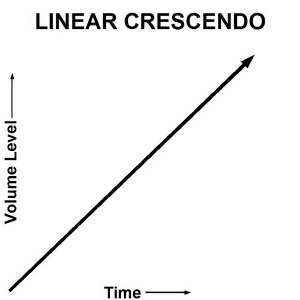
But it just didn't seem to come across as strongly as I wanted it to when I played back the recording. But on one take I accidentally played the phrase a little differently, and the crescendo was overwhelming—it just boomed out of the speakers clear as day. I listened a few times and realized I had shaped that crescendo like this (I call this an exponential crescendo; the word "exponential" describing a rate of increase which becomes quicker and quicker as the thing that increases becomes larger):
Ex. 2
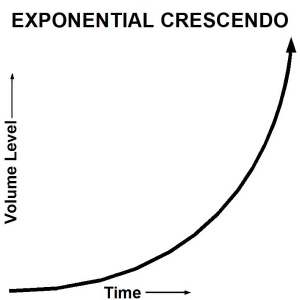
The exponential shape is far more obvious to the ear than the linear type.
Click here and listen to both types (Soundclip 5). (A separate window will open that you can minimize in order to still see the written musical example as you listen.)
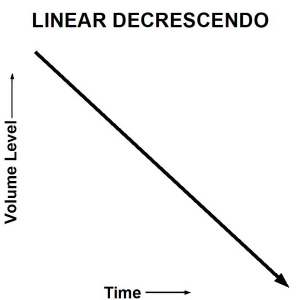
Decrescendos can also be executed both ways. The linear decrescendo or linear fade looks like this:
Ex. 3
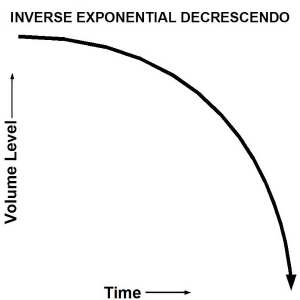
The inverse exponential decrescendo or fade (yes, I read too many audio books) looks like this:
Ex. 4
Now listen to these examples (Soundclip 6). (A separate window will open that you can minimize in order to still see the written musical example as you listen.)
No contest.
So this month's tip is quite simple. Within the confines of the musical requirements of the piece, when you play softly, play with a feather light touch. When you play loudly, play really strongly but don't let the tone quality "break" or distort. When making crescendos and decrescendos, don't make them linear--go exponential. Make your contrasts BIG. If you feel you are overdoing whatever dynamic effect you are trying to produce, your listeners are probably finally hearing what you are trying to communicate. In a word, EXAGGERATE!
PDFs and Video Downloads
You may download a PDF version of this technique tip.
Download Exaggerate Your Dynamics
Note: You must have Adobe Reader 10 or later installed on your computer to play the videos contained in the PDFs. Download Adobe Reader here.