Guitar Technique Tip of the Month
Your Personal Guitar Lesson


Contact Me
Do you have a question?
Comment?
Suggestion for the website?

PDFs and Video Downloads
You may download a PDF version of this technique tip.
Download Connecting a Single Melody Note to a Strummed or Arpeggiated Chord
Note: You must have Adobe Reader 10 or later installed on your computer to play the videos contained in the PDFs. Download Adobe Reader here.
Classical Guitar Technique
CONNECTING A SINGLE MELODY NOTE
TO A STRUMMED OR ARPEGGIATED CHORD
By Douglas Niedt
Copyright Douglas Niedt. All Rights Reserved. This article may be reprinted, but please be considerate and give credit to Douglas Niedt.
Below are the opening measures of Prelude No. 3 by Heitor Villa-Lobos.
Example #1:
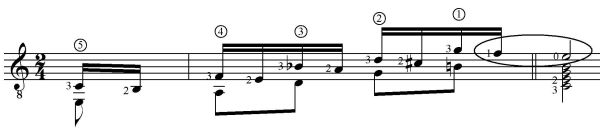
What is wrong with the way I am playing the single note F on the first string at the end of the second measure going into the strummed Cmaj7 chord of the third measure?
Listen to sound clip #1. (A separate window will open that you can minimize in order to still see the written musical example as you listen.)
Yes, there is a gap between the F and the high open E of the chord. These are both melody notes and should be seamless. There should be no dead space between them.
A lot of people lift the first-string F as soon as the thumb begins to play the fifth string C:
Example #2:
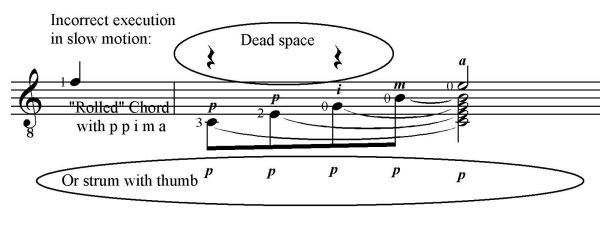
In slow motion, this incorrect execution sounds like this (sound clip #2). (A separate window will open that you can minimize in order to still see the written musical example as you listen.)
In slow motion, the correct execution of the transition from the first-string F to the open E looks like this:
Example #3:
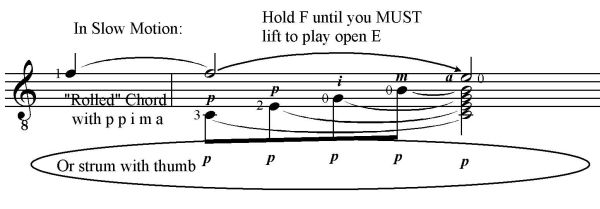
Correctly played, this is how it sounds in slow motion (soundclip 3). (A separate window will open that you can minimize in order to still see the written musical example as you listen.)
At tempo, this is what the actual execution would look like on the printed page:
Example #4:
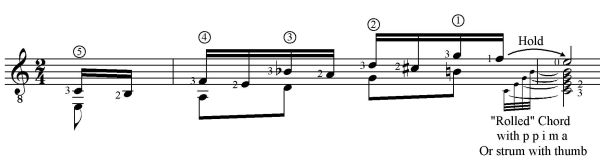
Correctly played, it sounds like this (soundclip #4). (A separate window will open that you can minimize in order to still see the written musical example as you listen.)
Notice that the transition from the single F to the open E of the chord is now seamless.
So here it is. This is the Technique Tip of the Month in one paragraph:
When you want to connect a single note (usually the melody) to the high note (again, usually the melody) of a strummed or argeggiated ("rolled") chord, do this: keep the single note held down until the moment when the right-hand thumb plays the high note of the chord (in the case of a thumb-strummed chord) or until the moment when the right-hand finger plucks the high note (in the case of a "rolled" chord).
Let's look at another example from the introduction of Capricho Árabe by Francisco Tárrega:
Example #5:

Listen to the melody played with incorrect execution (soundclip #5) in measure 3 to 4. (A separate window will open that you can minimize in order to still see the written musical example as you listen.)
There is a large gap between the 16th note E to the C# of the A major chord in measure four. Because these are the melody notes, they should be connected or legato. (I am assuming we want the A major chord to be strummed or "rolled." If we pluck the notes of the chord simultaneously, there is no problem connecting the melody notes.)
Let's look at it in slow motion. Many people would incorrectly lift the E on the second string as they began to play the fifth string open A of the A major chord:
Example #6
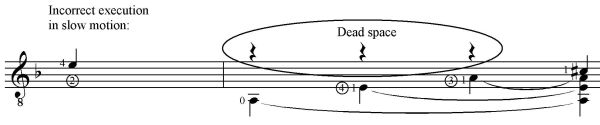
That sounds like this (soundclip #6). (A separate window will open that you can minimize in order to still see the written musical example as you listen.)
In slow motion, correct execution looks like this:
Example #7:

It sounds like this (soundclip #7). (A separate window will open that you can minimize in order to still see the written musical example as you listen.)
The actual execution of measures three to four would be notated like this:
Example #8:

Correct execution of measure 3-4 at tempo sounds like this (soundclip #8). (A separate window will open that you can minimize in order to still see the written musical example as you listen.)
Just to be sure, let's look at one more example. This is from Maria, also by Francisco Tárrega.
Example #9:

Again we are assuming the final chord will be "rolled" or arpeggiated. If the notes were played simultaneously, connecting the melody notes would be easier.
Listen to this example (soundclip #9). (A separate window will open that you can minimize in order to still see the written musical example as you listen.)
Notice the gap in the melody from the high D at the end of the first measure going to the high F of the chord in the second measure.
Incorrect execution in slow motion looks like this:
Example #10:
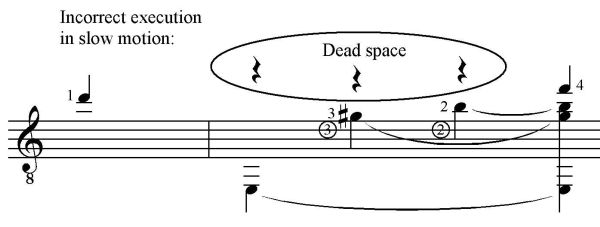
Incorrect execution in slow motion sounds like this (soundclip #10). (A separate window will open that you can minimize in order to still see the written musical example as you listen.)
Correct execution in slow motion looks like this:
Example #11:
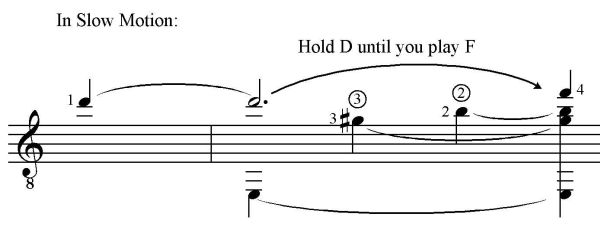
Correct execution in slow motion sounds like this (soundclip #11). (A separate window will open that you can minimize in order to still see the written musical example as you listen.)
Correct execution at tempo would be notated like this:
Example #12:
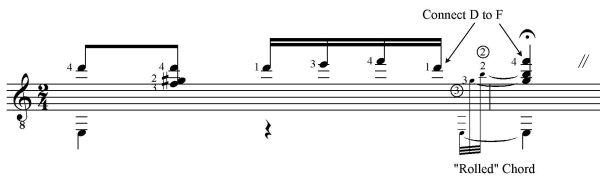
Correct execution at tempo sounds like this (Soundclip #12). (A separate window will open that you can minimize in order to still see the written musical example as you listen.)
Just a couple caveats. Yes there are always those pesky caveats. This technique applies only when going from a single note to an arpeggiated ("rolled") or thumb- strummed chord. If the notes of the chord are plucked simultaneously, there is usually no problem connecting the single note to the chord. We are also assuming we want the single note to melt seamlessly into the top note of the following chord. But there may be instances where a break in the sound is desired and this technique would not be applied.
Try out these examples and look for others in the music you are playing. You will definitely hear a more legato and more musical melody.
PDFs and Video Downloads
You may download a PDF version of this technique tip.
Download Connecting a Single Melody Note to a Strummed or Arpeggiated Chord
Note: You must have Adobe Reader 10 or later installed on your computer to play the videos contained in the PDFs. Download Adobe Reader here.