Guitar Technique Tip of the Month
Your Personal Guitar Lesson


Contact Me
Do you have a question?
Comment?
Suggestion for the website?

PDFs and Video Downloads
You may download a PDF version of this technique tip.
Download Practicing in Altered Rhythms
Note: You must have Adobe Reader 10 or later installed on your computer to play the videos contained in the PDFs. Download Adobe Reader here.
Classical Guitar Technique
PRACTICING IN ALTERED RHYTHMS
By Douglas Niedt
Copyright Douglas Niedt. All Rights Reserved. This article may be reprinted, but please be considerate and give credit to Douglas Niedt.
Do you ever reach a point in learning a piece where it just doesn’t seem to get any better? You still make mistakes in the same places or have difficulty with the same chord changes or scale passages? Or do you find that even when you play a piece you have been playing for years that the same passages still trip you up?
I learned how to overcome those difficulties from pianist Samuel Sanders, one of the most respected accompanists of the twentieth century. He was Itzhak Perlman’s chief accompanist from 1966-1999 and accompanist to Pinchas Zukerman, Paula Robison, Yo-Yo Ma, Joshua Bell, Mstislav Rostropovich, and many others.
His was a simple routine: practice at tempo, then slow, then with altered rhythms, and finally at half speed with a metronome. I think one of the key ingredients is practicing with altered rhythms.
Say you were having trouble with the final scales in the finale of Fernando Sor’s Introduction and Variations on a Theme by Mozart op.9. The scale seven measures from the end is written like this:
Ex. #1
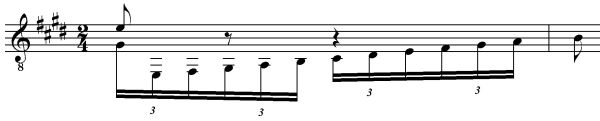
Listen to me play the original rhythm in sound clip #1.
(A separate window will open that you can minimize in order to still see the written musical example as you listen.)
Using Samuel Sanders’ routine, we would practice it at tempo, about MM=160 for an eighth note, or as fast as we could play it well. Then we would practice it slowly, maybe about MM=100 for an eighth note.
Then we would practice in altered rhythms. Here is one way in a long-short-short rhythmic pattern:
Ex. #2

Listen to me play it in sound clip #2.
(A separate window will open that you can minimize in order to still see the written musical example as you listen.)
Here is another version in a short-short-long rhythmic pattern:
Ex. #3

Listen to me play it in sound clip #3.
(A separate window will open that you can minimize in order to still see the written musical example as you listen.)
Here is yet another possibility in a dotted rhythm:
Ex. #4

Listen to me play it in sound clip #4.
(A separate window will open that you can minimize in order to still see the written musical example as you listen.)
Finally we would practice the original version at half speed, MM=80 for an eighth note.
For another example, let’s look at Bach’s Allemande from Lute Suite I BWV 996.
Ex. #5

Listen to me play the original rhythm in sound clip #5.
(A separate window will open that you can minimize in order to still see the written musical example as you listen.)
Here are a few possible versions in altered rhythms. First a dotted rhythm:
Ex. #6

Listen to me play it in sound clip 6.
(A separate window will open that you can minimize in order to still see the written musical example as you listen.)
Or a reverse dotted rhythm:
Ex. #7

Listen to me play it in sound clip #7.
(A separate window will open that you can minimize in order to still see the written musical example as you listen.)
Or a version in 12/8:
Ex. #8

Listen to me play it in sound clip #8.
(A separate window will open that you can minimize in order to still see the written musical example as you listen.)
Let's look at Antonio Lauro’s Vals Venezolana No. 3. Measures 18-20 are written originally as:
Ex. #9

Listen to me play it in sound clip #9.
(A separate window will open that you can minimize in order to still see the written musical example as you listen.)
They could be practiced in a dotted rhythm:
Ex. #10

Listen to me play it in sound clip #10.
(A separate window will open that you can minimize in order to still see the written musical example as you listen.)
Or in a reverse dotted rhythm:
Ex. #11

Listen to me play it in sound clip #11. (A separate window will open that you can minimize in order to still see the written musical example as you listen.)
In a "short-short-long" pattern:
Ex. #12

Listen to me play it in sound clip #12.
(A separate window will open that you can minimize in order to still see the written musical example as you listen.)
Or in a "long, short, short" pattern:
Ex. #13

Listen to me play it in sound clip #13.
(A separate window will open that you can minimize in order to still see the written musical example as you listen.)
Practicing in altered rhythms seems to break up muscle memory; especially old, entrenched muscle memory that produces the same mistakes day after day, month after month, even year after year. Although the tempo at which you practice the altered patterns doesn’t seem to be too critical to its benefits, I would try playing the altered versions on both the slow and fast side.
I recommend using the Samuel Sanders practice routine on brand new pieces as well. It will give you a lot more control of tricky passages and therefore help you relax during their execution.
Remember, practice at tempo, then slow, then with altered rhythms, and finally at half speed with a metronome. This really works. You’ve got to try it. You will be amazed by the results in just one to two days.
PDFs and Video Downloads
You may download a PDF version of this technique tip.
Download Practicing in Altered Rhythms
Note: You must have Adobe Reader 10 or later installed on your computer to play the videos contained in the PDFs. Download Adobe Reader here.